-1
archive,tag,tag-art-en,tag-144,qode-social-login-1.1.3,qode-restaurant-1.1.1,stockholm-core-2.3,select-child-theme-ver-1.1,select-theme-ver-8.9,ajax_fade,page_not_loaded,paspartu_enabled,menu-animation-underline,fs-menu-animation-underline,header_top_hide_on_mobile,,qode_grid_1300,qode_menu_center,qode-mobile-logo-set,wpb-js-composer js-comp-ver-6.6.0,vc_responsive

Exploring the uncanny: a zine


Zines as cultural infrastructure. A workshop at the 2024 global dis:connect summer school

Nikolai Brandes
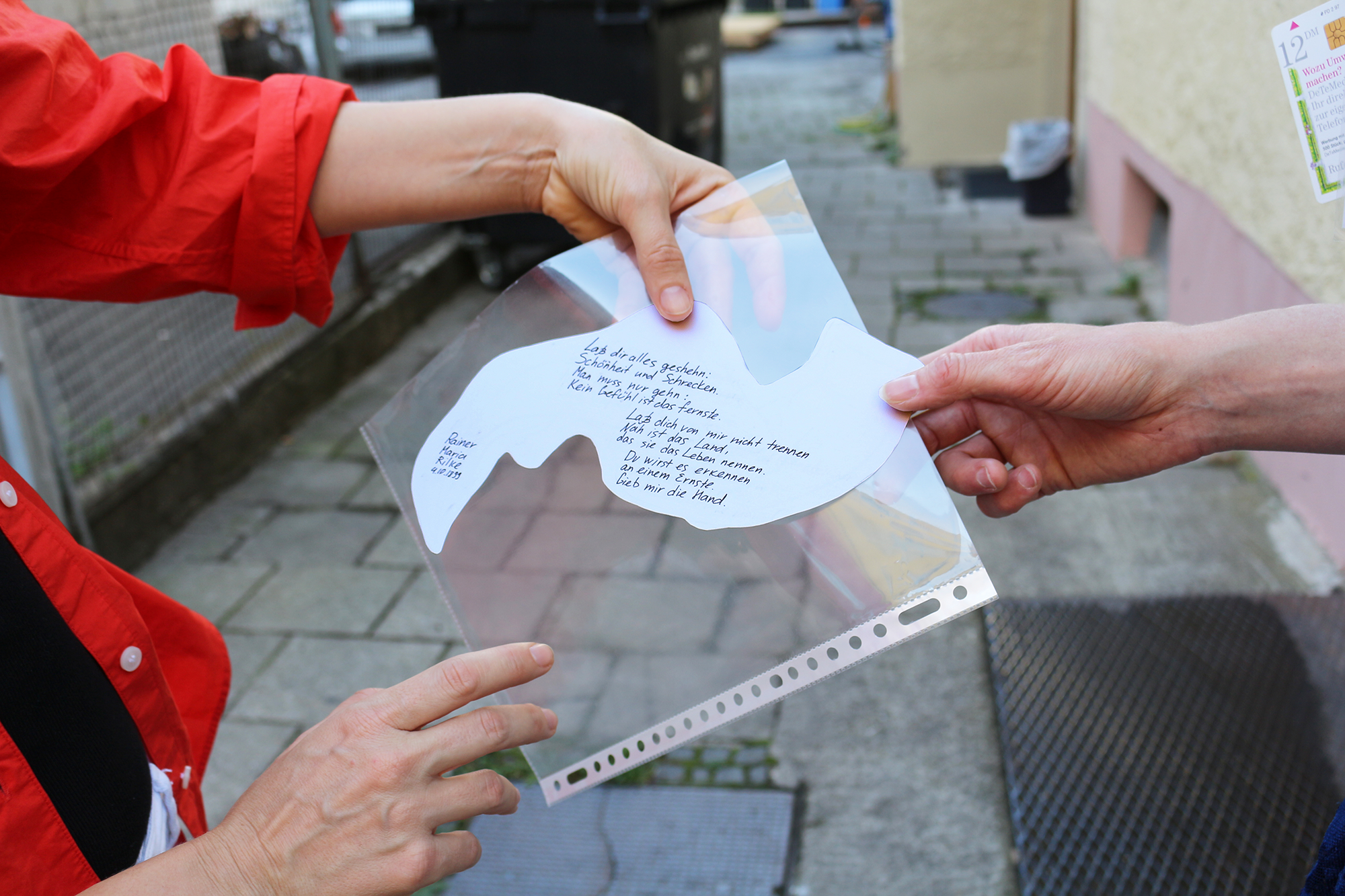
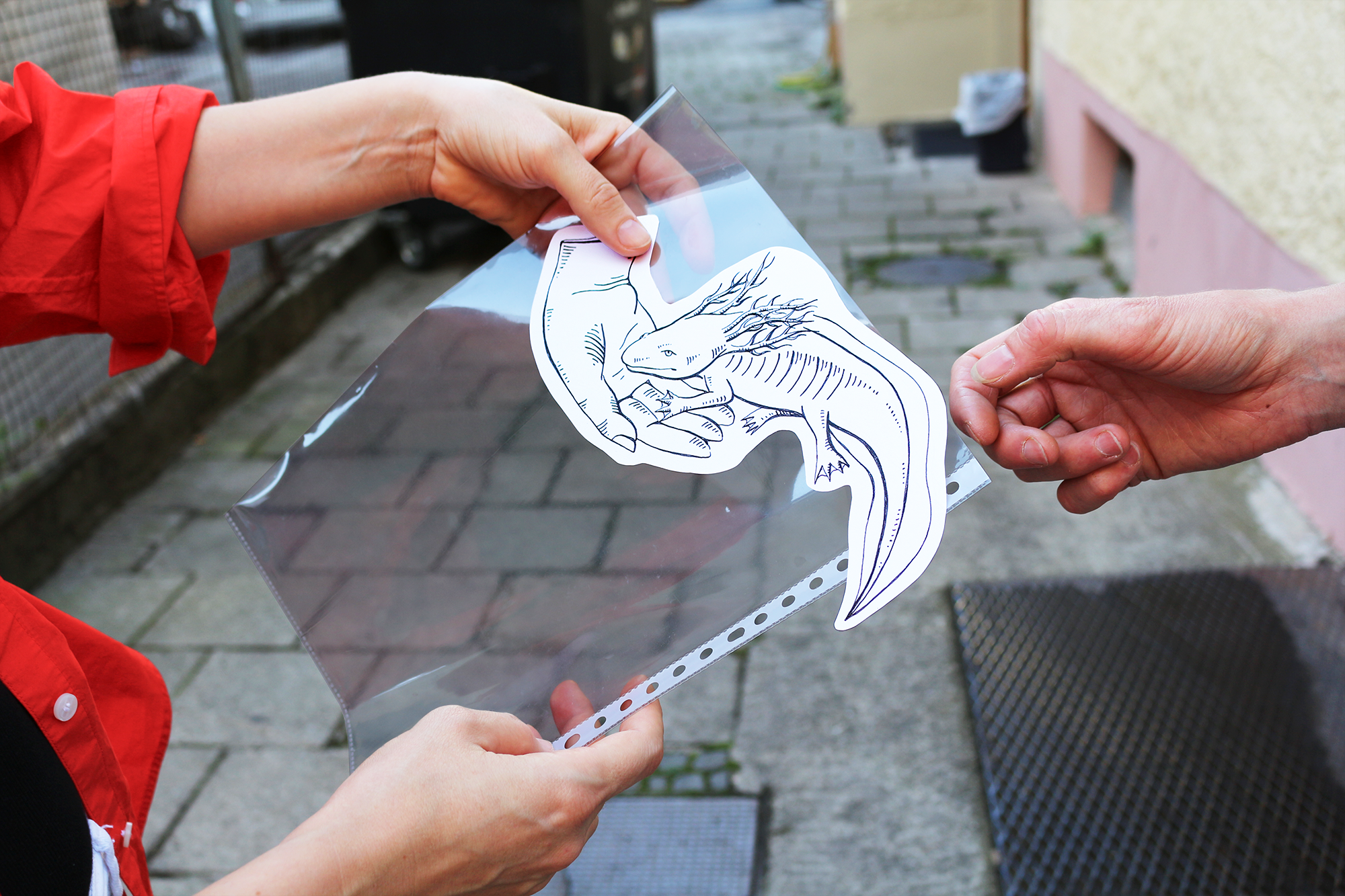
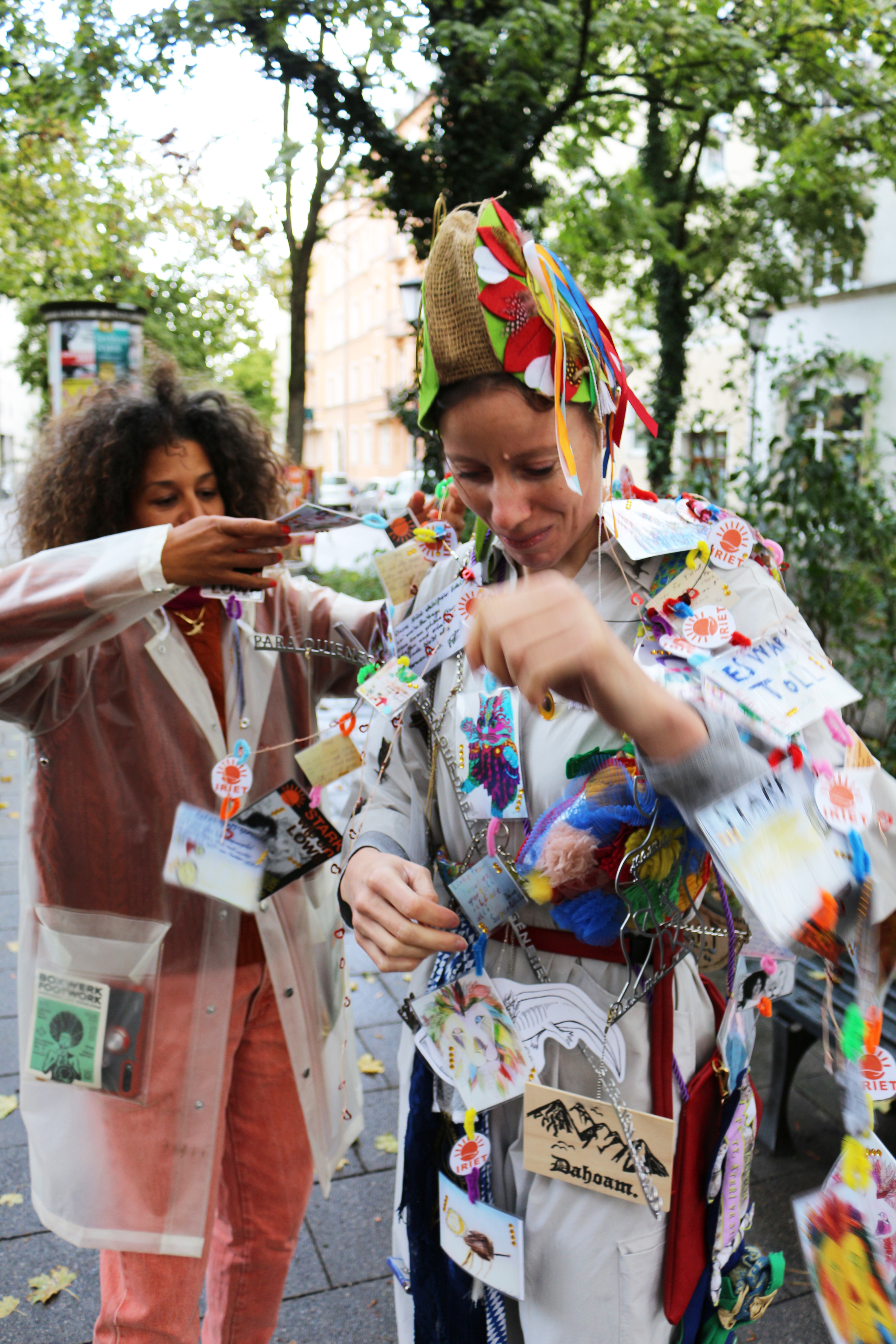
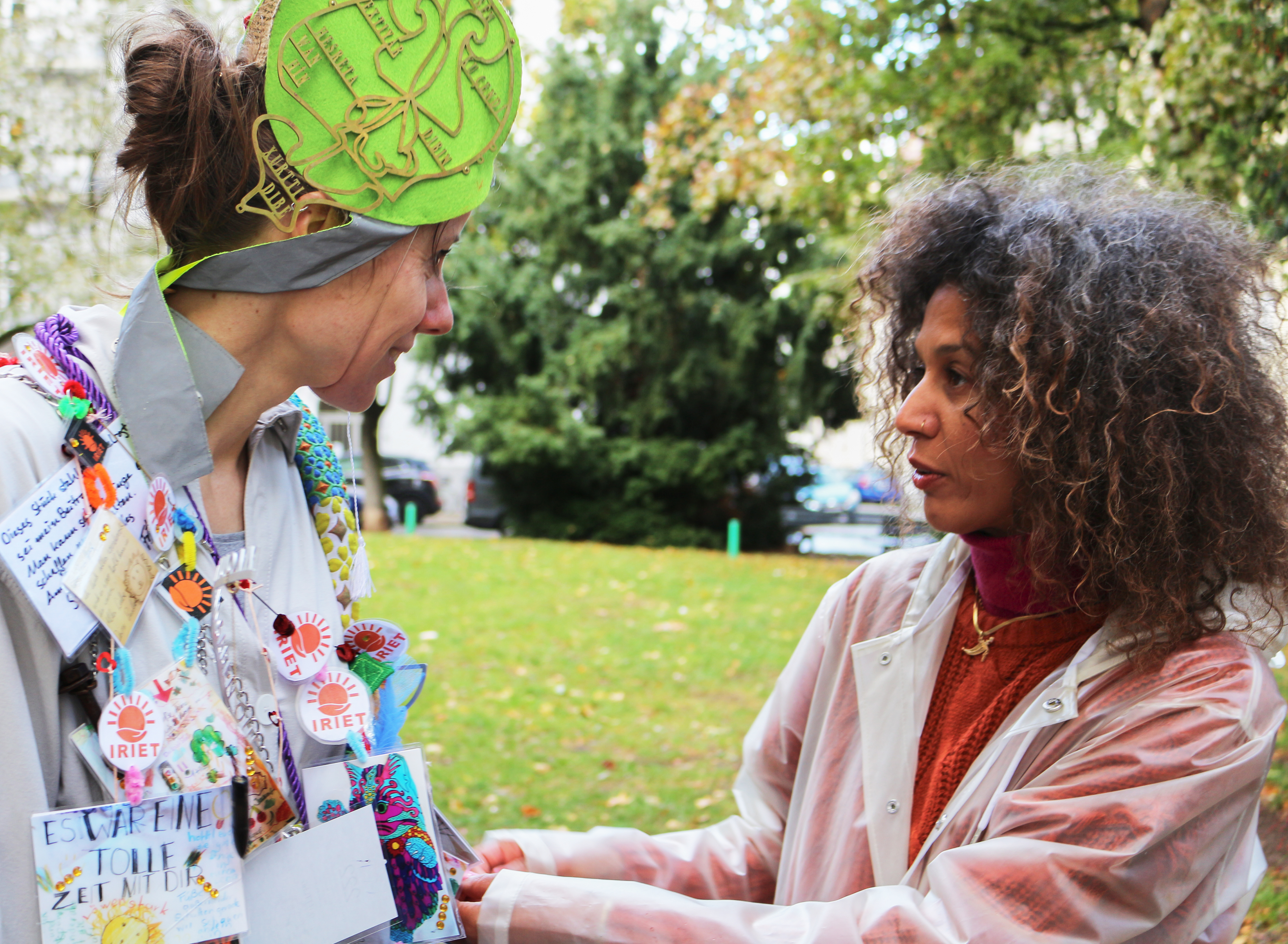
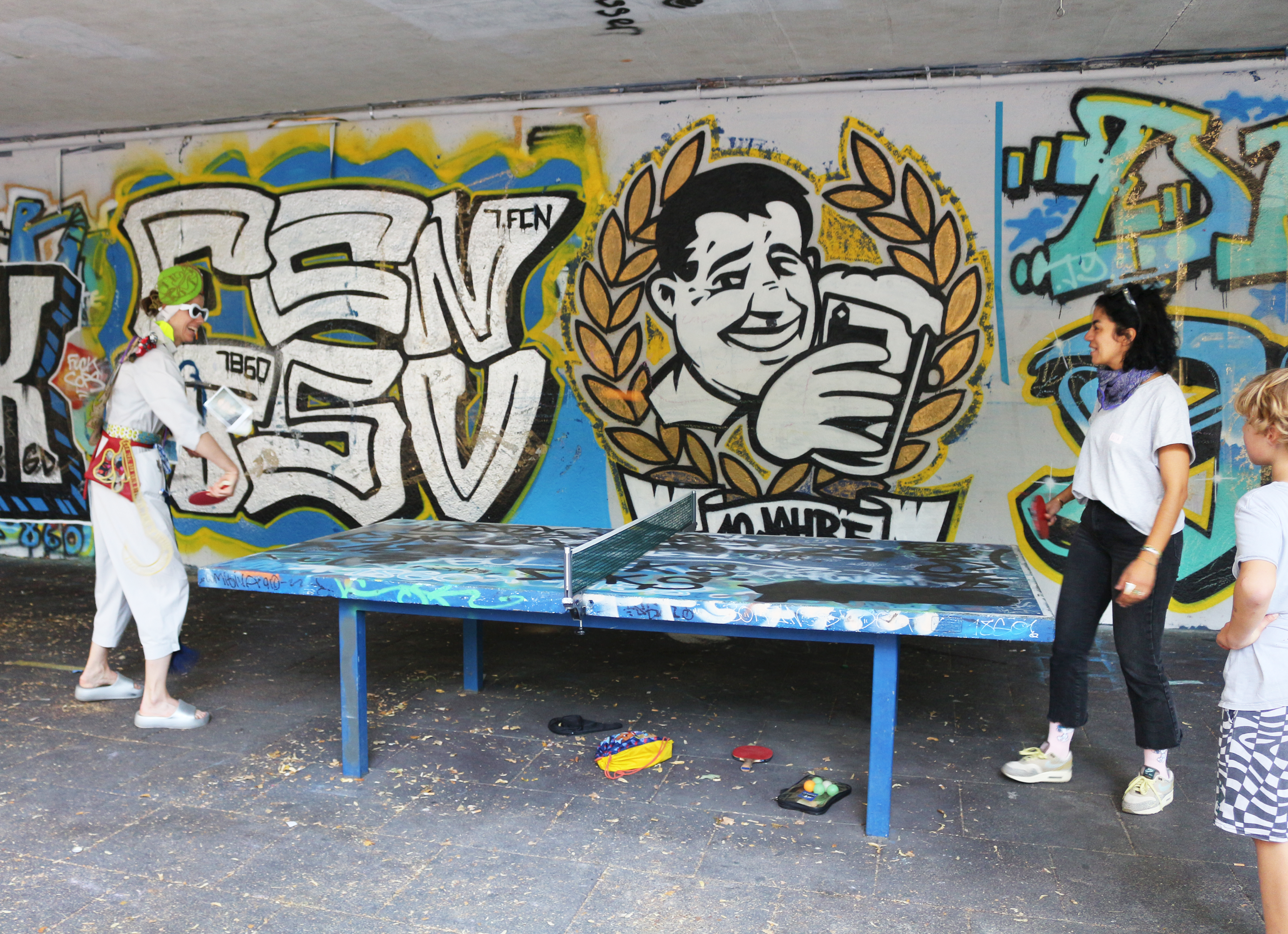
Punk, feminism, skateboarding, environmentalism, graffiti, queer culture: anyone who wanted to stay informed about social controversies, events and news from the underground scenes in the 1980s or 1990s could hardly do without zines. In many parts of the world, zines — DIY magazines produced by independent collectives on photocopiers and mimeographs — were a central communications medium in dissident scenes. They enabled dialogue on issues that were rarely covered in the mainstream media, received no public funding or were actively excluded from culture and its infrastructures, such as television, museums and movie theatres. The circulation of zines connected people with similar interests across cities and national borders. Zines helped to overcome political, spatial and social isolation.[1] When Moscow-based Dasha Sotnikova proposed holding a zine workshop at our 2024 global dis:connect summer school, we organisers were instantly intrigued. Our intention was to approach cultural infrastructures broadly and ask that they react to geopolitical disentanglements and exclusions in global flows of capital and cultural trends. We were interested in transformations of existing cultural platforms and the emergence of new infrastructures. Zines immediately appealed to us as an exciting subject.[3] Dasha's point of departure is her own experience in Russia. One might immediately think of the history of samizdat literature; that is, small-scale, grassroots publications used in the Soviet Union to circulate banned and deviant texts, including translations from abroad. Yes, Dasha is indeed interested in these historical references.[4] Still, the current global revival of zines is more than just an aesthetic phenomenon that satisfies a demand for analogue, collective work with genuine, tactile results. Zines continue to break down barriers and give space to subversive, unwanted, surprising voices. In her introductory presentation, Dasha showed what zine-making means for Russia's cultural underground, for communication with imprisoned dissidents and for exchange with nonconformists throughout the country. Our homemade zine was therefore about more than just creating an appealing product, a collective work process or experimenting with free-form text. Rather, the workshop was itself an exercise in building independent infrastructures with the simplest of means. (The shopping list Dasha sent me before the workshop included paper, black pens, needle and thread.) We not only learned about the Russian present, but also prepared ourselves for the not-so-unthinkable changes in our own environment. The directives from Bavarian authorities and universities to use gendered language and avoid more recent, inclusive terms in official publications and correspondence indicate how fragile freedom of speech can be, even in Germany. Here we share excerpts from the zine we compiled on the last day of our summer school under Dasha's guidance. We would like to thank all participants who agreed to publish their contributions and contributed to the process. Special thanks go to Tamara Zhukova, Olya Chermashentseva and Alisa Yamshchikova, who contributed to this zine from Moscow. We would also like to alert readers to the fact that some contributions touch on violence and rape. Please use discretion as to what’s right for you. [1] On zines as explicitly transnational media, see, for example, Babara Dynda, 'Queering Sexual and Gender Citizenship in (Anarcho-)Feminist Zines in Post-Socialist Poland', Journal of History 57, no. 3 (2022). [2] My fellow organisers included Christopher Balme, Hanni Geiger, Nic Leonhardt and Tom Menger. For more on this event, see https://www.globaldisconnect.org/wp-content/uploads/2024/01/CFP_gdc_summer_school_2024.pdf. [3] Some starting points for thinking about zines as infrastructure can be found in Maggie Matich, Elizabeth Parsons and Rachel Ashman, 'Zine Infrastructures as Forms of Organizing within Feminist Social Movements', Gender, Work & Organization 31, no. 3 (2022) https://doi.org/10.1111/gwao.12970. [4] For more on the continuity of alternative print media in Russian-speaking countries, see A.S. Metelkov, 'Alternative Book Publishing in Russia: from a Lubok to a Zine', Book. Reading. Media 2, no. 4 (2024) https://doi.org/10.20913/BRM-2-4-1.
Bibliography
Dynda, Babara. 'Queering Sexual and Gender Citizenship in (Anarcho-)Feminist Zines in Post-Socialist Poland'. Journal of History 57, no. 3 (2022): 385-419. Matich, Maggie, Elizabeth Parsons and Rachel Ashman. 'Zine Infrastructures as Forms of Organizing within Feminist Social Movements'. Gender, Work & Organization 31, no. 3 (2022): 1049-71. https://doi.org/https://doi.org/10.1111/gwao.12970. Metelkov, A.S. 'Alternative Book Publishing in Russia: from a Lubok to a Zine'. [In Russian]. Book. Reading. Media 2, no. 4 (2024): 255-66. https://doi.org/https://doi.org/10.20913/BRM-2-4-1.

From alienation to solidarity: communes and zines as new forms underground of cultural infrastructure

Dasha Sotnikova
THE RIGHT TO SPEAK The full-scale Russian invasion of Ukraine was (and remains) a mind-changing tragedy for many in the Russian opposition, including independent publishers and artists. As literature has always been a valuable cultural medium for Russophone culture, it could not help but respond to the invasion with the tools at its disposal. At the time, the literary agenda was fully dedicated to covering the tragedy, and no cultural or symbolic space remained in the underground artistic community for their artworks that tried to reflect on events sensitively. More importantly, after the initial affective artistic expressions and subsequent repression had transpired, the Russophone literary community had to reckon with their right to create their art in Russian — the official language of aggressor state. After continuous silence, we realized that, as artists, we can’t keep silent as long as we’re still alive, so we recalled the experience of dissident artists who managed to preserve underground culture even under past Soviet totalitarianism. (IR)RELEVANT INSPIRATION In the history of uncensored Soviet-era poetry, some underground cultural societies have united creators from very different fields. An outstanding example is the Moscow Conceptualist artistic movement founded by Ilya Kabakov, Viktor Pivovarov and Dmitry Alexandrovich Prigov. They experimented with postmodern combinations of pop-art, performance and visual poetry, problematising Soviet realism and the meaning of art itself. Beyond Conceptualist literature, samizdat was a unique cultural medium and alternative mode of expression for underground authors, such as Alexander Solzhenitsyn; Boris Pasternak; Mikhail Aizenberg; Elena Shvarts; Chuvashian poet Gennadii Aigi; the progenitors of barracks poetry, which revealed the horror of Soviet poverty, Yan Satunovsky, Igor Kholin, Genrikh Sapgir and dozens of others. Their texts would never be officially published in the Soviet Union, although their multicultural heritage significantly shaped modern Russophone art. With these impressive forbears in mind, we began to imagine ways of preserving underground culture. However, the current political situation differs much from that in the Soviet Union in two key respects. First is the escalation of Russian fascism, for which we too are responsible. Second, how cultural infrastructure works in Russia has changed greatly.

Anarchist poetry against imperialist narratives

In response to the first challenge, we sought to critically rethink the influence of so-called ‘classical’ Russian literature, its core figures and narratives. Government agencies have carefully curated this canon, gradually amplifying the imperialistic propaganda. The results of our critical reflection needed to be presented in new literary texts and literary critique. We address the second challenge of cultural infrastructure by creating new underground venues and forms of textual representation. Currently, as the right and possibility of preserving Russophone underground culture is seriously imperilled, poetry connected to anarchist currents is a cultural space where independent minds can still continue the tradition of dissident art, reflect on their personal responsibility for the ongoing violence of the Russian government and support its victims. And here, as in the gd:c summer school, I wish to share the ideas and findings of my friends — artists whose bravery I admire and who inspire me to struggle for peace and freedom.

Literary strategies to address xenophobia

One of the main trends of modern uncensored and unconventional Russophone poetry is a desire for intermediality and multilingualism. And it is more than a literary fad. The scariest consequence of the authoritarian regime suffered by ordinary residents is (self-)isolation, which (artificially) feeds xenophobia and exacerbates isolation. The only way to overcome it is to find the Other in oneself and to break the artificial boundary between friend and foe. That is why young poets and artists from Russia and Belarus, despite political persecution, work collectively and combine cinematic, poetic and artistic elements to overcome the isolation of a particular cultural field. In such conditions, the lack of cultural infrastructure is especially acute.

Where do we exist?

Safe spaces for mutually enriching dialogue among professional creators, investigators and people interested in modern culture; problematising governmental policy; and searching cooperatively for ways to express political opinions are vitally important functions of non-governmental cultural infrastructure, especially in authoritarian regimes. Although activism under the oppression of arbitrary state violence seems almost impossible, artistic practice remains one mode of struggle for personal identity and against those for whom any identity seems to be dangerous. After the war began, a few free and safe places remained for creators to maintain dialogue with poets and artists inside and outside Russia and to organise underground anti-war charity events and conferences. The venues were diverse: independent bookshops, theatres, cultural centres, libraries, galleries, pubs, university lecture halls. But now most of them are closed or under governmental control. However, the poetic flow has produced its own forms of free expression.

Artist communes

One format consists of performances followed by conceptual video artworks in the modern communes. They are produced by young people who continue to oppose the regime through art practices. Such performances mostly aim to raise money for political prisoners and refugees. In such structures, poetic and political values are often united, meaning solidarity, cooperation, horizontal connections and overcoming anthropocentrism. K is one such structure.[1] It is an independent cooperative that unites manufacturers, leftist thinkers and artists who refuse to collaborate with the government, and cooperative marketplaces. Their primary aim is to connect autonomous professionals to underground societies. All members take important decisions about the manufacturing process collectively and voluntarily choose their roles in it. Their principal aim is to attract donations to support non-commercial initiatives, such as venues for underground art festivals, activist projects, human rights organisations and crisis centres. Beyond this, they also try to preserve the independent underground initiatives that do still exist in modern Russia. In addition to their active manufacturing process, K’s residents contribute to the development of underground cultural processes, including writing and filmmaking. Apart from providing a free platform for cultural events, including poetry readings, book launches, performances and so on, they have set up a publishing house that prints modern leftist and anarchist zines as well as poetry books and cinema journals. Its founders claim that samizdat as a form of cultural infrastructure is valuable and necessary in authoritarian regimes; it is also the medium with the greatest artistic freedom and independence. It inspires artistic experiments and innovations with its bravery. For example, European black-metal and dungeon-synth fanzines as well as American libertarian science fiction and anarchist samizdat fascinate with their unique designs and unexpected content.

The cheaper, the freer

However, for samizdat production no publishing house is needed, as long as the authors can manage with the simplest materials and publication facilities. Samizdat zines have become one of the most accessible forms of cultural infrastructure, where diverse cultural, social and political narratives come together. Zines are becoming another venue for artistic dialogue and reflection. One example is Burning, a poetry zine by modern poet, videographer and performer M. The zine is based on a poetic cycle directly connected with current political events in Eastern Europe. The latter addresses the issue of breaking with one’s parents because of radically different political views. One of the author’s touchstone books about this problem is Powers of Horror by Julia Kristeva.[2] Its key metaphor, which significantly influenced the zine, refers to the milk foam that children in Soviet pioneer camps had to eat with hot milk, although most found it disgusting. Kristeva compares the act of vomiting this foam to emancipation from parental desire, which means obtaining subjectivity. The zine probes childhood as an uncomfortable and unsafe space, despite the kitsch view of childhood as a carefree paradise. All in all, the zine is about catastrophe, in the face of which all the opposition members are equal. That is why the zine aims to transcend the deification of the author, whose putatively privileged vantage point might let them communicate some special truth to the readers. This idea is expressed through the format of zine and its content. The zine consists of six poems and imitates the design of an official document. This design reflects the feeling of being swallowed by violent governmental machine, where a person’s life and death are determined by a signature on senseless paper, such as a draft card. The images, digitally composed and edited, contain simulated mugshots of the authors' friends. The layout was printed on a risograph, which is how the cheapest issues are produced. This technical decision helped to stylise the zine according to the author’s aim of self-elimination. Apart from the great number of artefacts, such as erased faces and torn paper, left by the risograph, the author used the simplest font available: Times New Roman. Finally, the design communicates the eerie feeling that children in Soviet (and modern) Russian kindergartens and schools experience. Samizdat zines are normally limited print runs of 100 copies and distributed through independent bookshops (that is, those that sell uncensored literature) and social networks. Common sensitive topics, the desire to express one's genuine political views and the cheapest publication process unite modern dissident poetry culture with Soviet samizdat culture. These projects and processes are important to me, although there are other valuable issues and performances beyond such manifestations of modern Russian dissident culture. Obviously, local resistance to the repressive policy of the fascist government may not make much difference on a global scale, but it does affect interpersonal relations. Modern underground culture lets us preserve the solidarity that the state’s authoritarian violence seeks to take from us. However, all these intentions are insufficient without transitional resonance, and I'm eager to maintain connections with artists from different cultural backgrounds who share similar aims. Xenophobia and alienation are not national problems, so we need sincerity and courage to face them all together. We believe that the world shifts each time we choose solidarity instead of fear and open dialog instead of violence. [1] The single-letter pseudonyms in this piece are to protect the organisations and individuals involved from persecution. [2] Julia Kristeva, Powers of Horror: An Essay on Abjection, trans. Leon Roudiez (New York: Columbia University Press, 1982).
Bibliography
Kristeva, Julia. Powers of Horror: An Essay on Abjection. Translated by Leon Roudiez. New York: Columbia University Press, 1982.

Exploring the uncanny

Continue Reading

Exploring the uncanny: a zine

[Editor's note: the fourth anniversary of the Russian invasion of Ukraine was last week. To recall that event and to help prevent it from being forgotten amid the other recent invasions and acts of aggression, we're publishing this zine created by Russian dissidents and participants of the 2024 gd:c summer school. The first text is an introduction of the project by gd:c alumnus Nikolai Brandes, upon which follows an introduction to zines as a dissident medium by Dasha Sotnikova, the zine's creative progenitor, and finally the zine itself. Enjoy. Remember. Fight.]

Zines as cultural infrastructure. A workshop at the 2024 global dis:connect summer school

Nikolai Brandes
  Punk, feminism, skateboarding, environmentalism, graffiti, queer culture: anyone who wanted to stay informed about social controversies, events and news from the underground scenes in the 1980s or 1990s could hardly do without zines. In many parts of the world, zines — DIY magazines produced by independent collectives on photocopiers and mimeographs — were a central communications medium in dissident scenes. They enabled dialogue on issues that were rarely covered in the mainstream media, received no public funding or were actively excluded from culture and its infrastructures, such as television, museums and movie theatres. The circulation of zines connected people with similar interests across cities and national borders. Zines helped to overcome political, spatial and social isolation.[1] When Moscow-based Dasha Sotnikova proposed holding a zine workshop at our 2024 global dis:connect summer school, we organisers were instantly intrigued. Our intention was to approach cultural infrastructures broadly and ask that they react to geopolitical disentanglements and exclusions in global flows of capital and cultural trends. We were interested in transformations of existing cultural platforms and the emergence of new infrastructures. Zines immediately appealed to us as an exciting subject.[3] Dasha's point of departure is her own experience in Russia. One might immediately think of the history of samizdat literature; that is, small-scale, grassroots publications used in the Soviet Union to circulate banned and deviant texts, including translations from abroad. Yes, Dasha is indeed interested in these historical references.[4] Still, the current global revival of zines is more than just an aesthetic phenomenon that satisfies a demand for analogue, collective work with genuine, tactile results. Zines continue to break down barriers and give space to subversive, unwanted, surprising voices. In her introductory presentation, Dasha showed what zine-making means for Russia's cultural underground, for communication with imprisoned dissidents and for exchange with nonconformists throughout the country. Our homemade zine was therefore about more than just creating an appealing product, a collective work process or experimenting with free-form text. Rather, the workshop was itself an exercise in building independent infrastructures with the simplest of means. (The shopping list Dasha sent me before the workshop included paper, black pens, needle and thread.) We not only learned about the Russian present, but also prepared ourselves for the not-so-unthinkable changes in our own environment. The directives from Bavarian authorities and universities to use gendered language and avoid more recent, inclusive terms in official publications and correspondence indicate how fragile freedom of speech can be, even in Germany. Here we share excerpts from the zine we compiled on the last day of our summer school under Dasha's guidance. We would like to thank all participants who agreed to publish their contributions and contributed to the process. Special thanks go to Tamara Zhukova, Olya Chermashentseva and Alisa Yamshchikova, who contributed to this zine from Moscow. We would also like to alert readers to the fact that some contributions touch on violence and rape. Please use discretion as to what’s right for you.   [1] On zines as explicitly transnational media, see, for example, Babara Dynda, 'Queering Sexual and Gender Citizenship in (Anarcho-)Feminist Zines in Post-Socialist Poland', Journal of History 57, no. 3 (2022). [2] My fellow organisers included Christopher Balme, Hanni Geiger, Nic Leonhardt and Tom Menger. For more on this event, see https://www.globaldisconnect.org/wp-content/uploads/2024/01/CFP_gdc_summer_school_2024.pdf. [3] Some starting points for thinking about zines as infrastructure can be found in Maggie Matich, Elizabeth Parsons and Rachel Ashman, 'Zine Infrastructures as Forms of Organizing within Feminist Social Movements', Gender, Work & Organization 31, no. 3 (2022) https://doi.org/10.1111/gwao.12970. [4] For more on the continuity of alternative print media in Russian-speaking countries, see A.S. Metelkov, 'Alternative Book Publishing in Russia: from a Lubok to a Zine', Book. Reading. Media 2, no. 4 (2024) https://doi.org/10.20913/BRM-2-4-1.
Bibliography
Dynda, Babara. 'Queering Sexual and Gender Citizenship in (Anarcho-)Feminist Zines in Post-Socialist Poland'. Journal of History 57, no. 3 (2022): 385-419. Matich, Maggie, Elizabeth Parsons and Rachel Ashman. 'Zine Infrastructures as Forms of Organizing within Feminist Social Movements'. Gender, Work & Organization 31, no. 3 (2022): 1049-71. https://doi.org/https://doi.org/10.1111/gwao.12970. Metelkov, A.S. 'Alternative Book Publishing in Russia: from a Lubok to a Zine'. [In Russian]. Book. Reading. Media 2, no. 4 (2024): 255-66. https://doi.org/https://doi.org/10.20913/BRM-2-4-1.  

From alienation to solidarity: communes and zines as new forms underground of cultural infrastructure

Dasha Sotnikova
  THE RIGHT TO SPEAK The full-scale Russian invasion of Ukraine was (and remains) a mind-changing tragedy for many in the Russian opposition, including independent publishers and artists. As literature has always been a valuable cultural medium for Russophone culture, it could not help but respond to the invasion with the tools at its disposal. At the time, the literary agenda was fully dedicated to covering the tragedy, and no cultural or symbolic space remained in the underground artistic community for their artworks that tried to reflect on events sensitively. More importantly, after the initial affective artistic expressions and subsequent repression had transpired, the Russophone literary community had to reckon with their right to create their art in Russian — the official language of aggressor state. After continuous silence, we realized that, as artists, we can’t keep silent as long as we’re still alive, so we recalled the experience of dissident artists who managed to preserve underground culture even under past Soviet totalitarianism.   (IR)RELEVANT INSPIRATION In the history of uncensored Soviet-era poetry, some underground cultural societies have united creators from very different fields. An outstanding example is the Moscow Conceptualist artistic movement founded by Ilya Kabakov, Viktor Pivovarov and Dmitry Alexandrovich Prigov. They experimented with postmodern combinations of pop-art, performance and visual poetry, problematising Soviet realism and the meaning of art itself. Beyond Conceptualist literature, samizdat was a unique cultural medium and alternative mode of expression for underground authors, such as Alexander Solzhenitsyn; Boris Pasternak; Mikhail Aizenberg; Elena Shvarts; Chuvashian poet Gennadii Aigi; the progenitors of barracks poetry, which revealed the horror of Soviet poverty, Yan Satunovsky, Igor Kholin, Genrikh Sapgir and dozens of others. Their texts would never be officially published in the Soviet Union, although their multicultural heritage significantly shaped modern Russophone art. With these impressive forbears in mind, we began to imagine ways of preserving underground culture. However, the current political situation differs much from that in the Soviet Union in two key respects. First is the escalation of Russian fascism, for which we too are responsible. Second, how cultural infrastructure works in Russia has changed greatly.

Anarchist poetry against imperialist narratives

In response to the first challenge, we sought to critically rethink the influence of so-called ‘classical’ Russian literature, its core figures and narratives. Government agencies have carefully curated this canon, gradually amplifying the imperialistic propaganda. The results of our critical reflection needed to be presented in new literary texts and literary critique. We address the second challenge of cultural infrastructure by creating new underground venues and forms of textual representation. Currently, as the right and possibility of preserving Russophone underground culture is seriously imperilled, poetry connected to anarchist currents is a cultural space where independent minds can still continue the tradition of dissident art, reflect on their personal responsibility for the ongoing violence of the Russian government and support its victims. And here, as in the gd:c summer school, I wish to share the ideas and findings of my friends — artists whose bravery I admire and who inspire me to struggle for peace and freedom.

Literary strategies to address xenophobia

One of the main trends of modern uncensored and unconventional Russophone poetry is a desire for intermediality and multilingualism. And it is more than a literary fad. The scariest consequence of the authoritarian regime suffered by ordinary residents is (self-)isolation, which (artificially) feeds xenophobia and exacerbates isolation. The only way to overcome it is to find the Other in oneself and to break the artificial boundary between friend and foe. That is why young poets and artists from Russia and Belarus, despite political persecution, work collectively and combine cinematic, poetic and artistic elements to overcome the isolation of a particular cultural field. In such conditions, the lack of cultural infrastructure is especially acute.

Where do we exist?

Safe spaces for mutually enriching dialogue among professional creators, investigators and people interested in modern culture; problematising governmental policy; and searching cooperatively for ways to express political opinions are vitally important functions of non-governmental cultural infrastructure, especially in authoritarian regimes. Although activism under the oppression of arbitrary state violence seems almost impossible, artistic practice remains one mode of struggle for personal identity and against those for whom any identity seems to be dangerous. After the war began, a few free and safe places remained for creators to maintain dialogue with poets and artists inside and outside Russia and to organise underground anti-war charity events and conferences. The venues were diverse: independent bookshops, theatres, cultural centres, libraries, galleries, pubs, university lecture halls. But now most of them are closed or under governmental control. However, the poetic flow has produced its own forms of free expression.

Artist communes

One format consists of performances followed by conceptual video artworks in the modern communes. They are produced by young people who continue to oppose the regime through art practices. Such performances mostly aim to raise money for political prisoners and refugees. In such structures, poetic and political values are often united, meaning solidarity, cooperation, horizontal connections and overcoming anthropocentrism. K is one such structure.[1] It is an independent cooperative that unites manufacturers, leftist thinkers and artists who refuse to collaborate with the government, and cooperative marketplaces. Their primary aim is to connect autonomous professionals to underground societies. All members take important decisions about the manufacturing process collectively and voluntarily choose their roles in it. Their principal aim is to attract donations to support non-commercial initiatives, such as venues for underground art festivals, activist projects, human rights organisations and crisis centres. Beyond this, they also try to preserve the independent underground initiatives that do still exist in modern Russia. In addition to their active manufacturing process, K’s residents contribute to the development of underground cultural processes, including writing and filmmaking. Apart from providing a free platform for cultural events, including poetry readings, book launches, performances and so on, they have set up a publishing house that prints modern leftist and anarchist zines as well as poetry books and cinema journals. Its founders claim that samizdat as a form of cultural infrastructure is valuable and necessary in authoritarian regimes; it is also the medium with the greatest artistic freedom and independence. It inspires artistic experiments and innovations with its bravery. For example, European black-metal and dungeon-synth fanzines as well as American libertarian science fiction and anarchist samizdat fascinate with their unique designs and unexpected content.

The cheaper, the freer

However, for samizdat production no publishing house is needed, as long as the authors can manage with the simplest materials and publication facilities. Samizdat zines have become one of the most accessible forms of cultural infrastructure, where diverse cultural, social and political narratives come together. Zines are becoming another venue for artistic dialogue and reflection. One example is Burning, a poetry zine by modern poet, videographer and performer M. The zine is based on a poetic cycle directly connected with current political events in Eastern Europe. The latter addresses the issue of breaking with one’s parents because of radically different political views. One of the author’s touchstone books about this problem is Powers of Horror by Julia Kristeva.[2] Its key metaphor, which significantly influenced the zine, refers to the milk foam that children in Soviet pioneer camps had to eat with hot milk, although most found it disgusting. Kristeva compares the act of vomiting this foam to emancipation from parental desire, which means obtaining subjectivity. The zine probes childhood as an uncomfortable and unsafe space, despite the kitsch view of childhood as a carefree paradise. All in all, the zine is about catastrophe, in the face of which all the opposition members are equal. That is why the zine aims to transcend the deification of the author, whose putatively privileged vantage point might let them communicate some special truth to the readers. This idea is expressed through the format of zine and its content. The zine consists of six poems and imitates the design of an official document. This design reflects the feeling of being swallowed by violent governmental machine, where a person’s life and death are determined by a signature on senseless paper, such as a draft card. The images, digitally composed and edited, contain simulated mugshots of the authors' friends. The layout was printed on a risograph, which is how the cheapest issues are produced. This technical decision helped to stylise the zine according to the author’s aim of self-elimination. Apart from the great number of artefacts, such as erased faces and torn paper, left by the risograph, the author used the simplest font available: Times New Roman. Finally, the design communicates the eerie feeling that children in Soviet (and modern) Russian kindergartens and schools experience. Samizdat zines are normally limited print runs of 100 copies and distributed through independent bookshops (that is, those that sell uncensored literature) and social networks. Common sensitive topics, the desire to express one's genuine political views and the cheapest publication process unite modern dissident poetry culture with Soviet samizdat culture. These projects and processes are important to me, although there are other valuable issues and performances beyond such manifestations of modern Russian dissident culture. Obviously, local resistance to the repressive policy of the fascist government may not make much difference on a global scale, but it does affect interpersonal relations. Modern underground culture lets us preserve the solidarity that the state’s authoritarian violence seeks to take from us. However, all these intentions are insufficient without transitional resonance, and I'm eager to maintain connections with artists from different cultural backgrounds who share similar aims. Xenophobia and alienation are not national problems, so we need sincerity and courage to face them all together. We believe that the world shifts each time we choose solidarity instead of fear and open dialog instead of violence. [1] The single-letter pseudonyms in this piece are to protect the organisations and individuals involved from persecution. [2] Julia Kristeva, Powers of Horror: An Essay on Abjection, trans. Leon Roudiez (New York: Columbia University Press, 1982).
Bibliography
Kristeva, Julia. Powers of Horror: An Essay on Abjection. Translated by Leon Roudiez. New York: Columbia University Press, 1982.  

Exploring the uncanny

Continue Reading

Facing Gaia: Justin Brice Guariglia’s landscape photography in an ecological perspective

peter seeland
  In 2015, artist Justin Brice Guariglia participated in NASA's Operation Ice Bridge, flying over Greenland and photographing the Galloping Glacier near Jacobshavn. This glacier is among the fastest melting in the world, and few places illustrate the effects of climate change as starkly.[1] Guariglia observed the melting ice and heard the cracks splitting the archipelago. Later, he spent months working with gesso, acrylic and plastics on these photographs, creating tactile surface textures like Jacobshavn I (Fig. 1, 2).[2]

Fig. 1: Justin Brice Guariglia: JACOBSHAVN I, 2015/2016, Acryl, Polystyrene Panel, 325.12 x 243.84 x 4.44 cm, Private Collection. (reproduced with artist’s permission)

  A year later and about 800 kilometres northwest of Jacobshavn, French philosopher and sociologist Bruno Latour flew over Baffin Island to Canada, where he spoke on perceptions of nature in the era of climate change. From the airplane, he looked down on Earth. Baffin Island, the largest island in the Canadian Arctic Archipelago, has been covered with ice for millennia. Yet, instead of a frozen white desert, Latour saw barren tundra for hours. In recent decades, the island's ice sheets have retreated by more than half due to global warming, and during the 2016 heatwave the island was almost ice-free.[3] Latour was deeply affected by the sight of the cracked, sparse ice. Bitterly, he compared the ravaged landscape to the tortured face and surface of Munch's The Scream. He said, ‘It was as though the ice was sending me a message’.[4] Greenland and the Arctic are considered ‘ground-zero zones’[5] of climate change, and it's telling that both Guariglia and Latour are so moved by these landscapes. The artificial transformation of nature becomes a visual experience for both, and it seems to be a new experience and a new relation to nature that is emerging through this direct confrontation. Latour describes the experience as an emotional dialogue, and Guariglia processes it through art. So, to what extent is Jacobshavn I a new image of nature and of a changing relationship between us and nature? How can comparing Latour’s theories and Guariglia’s art help us think through the climate crisis? This essay compares Guariglia’s artistic treatment of the Anthropocene with Latour’s theoretical approach, contextualising both in the broader discourse on the Anthropocene. This comparison demonstrates how art can reflect the relationship between humans and nature. Additionally, it illustrates how art can foster the creation of new, less destructive representations of nature, which are attuned to the challenges of the Anthropocene. Art could thus shift consciousness, providing a novel approach to the challenges of the Anthropocene.

Art and ecology

Researching contemporary art from an ecological perspective involves integrating environmental crises, their impacts on our conceptions of ourselves as humans, how we understand nature, and how we deal with them. It also entails investigating the relationship between humans and nature. These discussions are often labelled with the term Anthropocene, omnipresent in popular and academic discourses. Sometimes appearing in unreliable articles, sometimes taken as a given in serious discussions, or heavily criticised by researchers, the term is plagued by confusion.[6] The literature counts many essays on the Anthropocene and its impact on humans, culture and society, often under the umbrella of ecocriticism in philosophy, sociology, history and literary criticism, including aesthetics and art.[7] Bruno Latour, a luminary in the Anthropocene discourse, has engaged intensely with ecology, art and the humanities.[8] As Phillipe Pignarre notes, ‘Latour is really the thinker of the Anthropocene’.[9]

Jacobshavn I and the Anthropocene discourse

Jacobshavn I is intertwined with aspects of Latour's thought and the Anthropocene discourse in general. Knowing that Guariglia engages deeply with the discourse of Anthropocene, several pivotal aspects of the discourse and how viewers perceive Jacobshavn I.

Disorientation

The object depicted in the work remains utterly vague. Various visual elements intensify the disorientation, including the perspective, the size and the materiality of the representation. The image implies no particular vantage point, leaving the viewer's position unclear and compelling them back into their own subjective standpoint. Such disorientation characterises the Anthropocene. Bruno Latour diagnoses a new climate regime in the Anthropocene, as nature becomes a decisive actor.[10] A nature previously passive and objectified suddenly becomes an active, potent actor. This leaves humans in aporia, completely alienated from such nature. Further, nature as the setting of human existence and experience threatens to dissolve. The destructive element of changing the natural environment induces ontological upheaval of the world's structure, according to Latour.[11] Nature is no longer a constant. Humans have no fixed point to position themselves in the world's structure.[12] Jacobshavn I mirrors this disorientation. The lack of Euclidean perspective reflects the subject's aporia in understanding nature through the Anthropocene.[13]  

Fig. 2: Detail: Justin Brice Guariglia: JACOBSHAVN I, 2015/2016, Acryl, Polystyrene Panel, 325,12 x 4,44 cm, Private Collection. (reproduced with artist’s permission)

Unreadability

The representation is also unreadable, which recalls and surpasses disorientation. Every visual detail eludes reference; it remains entirely unclear what material is depicted where. The representation resists any cultural and subjective assimilation by the viewer, defying intuitive understanding. Unreadability is also present in the Anthropocene discourse. The Anthropocene is characterised by a ‘clash of scales’.[14] Scales that elude human perception are juxtaposed. The spatial scales of global crises, the temporality of millennia into the future and past and the quantitative dimensions of pollutants and destruction are hardly imaginable, let alone perceptible. The point of no return, when Earth's equilibrium catastrophically tips, exceeds human imagination. Thus, unreadability is inherent to the Anthropocene.[15] Guariglia evokes unreadability through form. The monumental white in Jacobshavn I also evokes unreadability by swallowing details and dazzling the viewer. The dominance of white recalls the ubiquity and therefore the ungraspable nature of the Anthropocene.[16] Latour also notes that previous concepts of nature and Earth deviate from reality, as symbolised by globes and maps.[17] Latour sees this deviation as a hallmark of modernity and defines it as the state in which every connection between our imagination of the world and its reality independent of us is severed. In this state, humans have lost the ability to perceive true nature.[18] It has become unfathomable, just like Jacobshavn I.

Interconnectedness

Paradoxically, the disorientation and unreadability connect the viewer to the work. The unfinished cognitive and perceptual processes demand resolution. The work appears simultaneously near and distant, familiar and strange. This dis:connectivity is also present in the Anthropocene discourse. Recognising the catastrophic consequences of dichotomising nature in the 20th century, James Lovelock and Lynn Margulis developed the Gaia hypothesis in the 1970s.[19] This introduces a holistic understanding of nature, radically departing from modern dualism.[20] With Gaia, the Greek deity and personification of Earth, they symbolically refer to nature as a network of all organisms, including humans and animals in addition to rivers, mountains, and the micro- and macrocosmos. Nature is therefore a planetary collaborative-processual network that integrates humans as one part among others. Humans are not outside nature but an integral part of it. We are deeply connected and existentially bound to the network, and the network’s existence depends on our prudent interaction with the environment.[21] Hence, a posthumanist image of humanity and nature emerges. Nature is no longer the other, the observed and the foreign; humans are part of it. The separation of subject and object collapses, forming the conceptual basis of the Anthropocene.[22] Bruno Latour, building on the Gaia hypothesis, refers to this understanding of nature as the Terrestrial. He implies reciprocity between humans and the world, positioning humans as actors among many equivalent actors in the network. Humans are not the counterpart of the world but immanent within it. The goal of Latour's anthropology of modernity is to dissolve the separation of humans from nature, revealing it as an ideological construction.[23] Interconnectedness is thus an essential component of both the Anthropocene discourse and Guariglia's work. The complex and seemingly insoluble entanglement of viewer and artwork reflects the dis:connective human-nature relationship advocated by Latour.

Uncanniness

Disorienting, unreadable, disconnected and yet connected, Jacobshavn I evokes discomfort and uncanniness. It is not the familiar and comfortable image of nature emphasising beauty; it is uncanny and strange. As Beatrice Galilee, curator at the Metropolitan Museum, describes Guariglia’s works, they are ‘beautiful but terrifying’.[24] This uncanniness is also present in the Anthropocene discourse. Thomas Friedman refers to this relationship with an incomprehensible world we are destroying ‘global weirding’.[25] The writer Amitav Ghosh says nature now reciprocates the human gaze, becoming alive in an uncanny yet familiar way.[26] Thus, in the Anthropocene, humans share their consciousness uncannily with other beings, perhaps even with the planet itself. Humans are inseparably connected to nature, so we can no longer retreat to our subjectivity or reduce nature to objectivity. Horn, invoking Kant, calls this the ‘Sublime in the Anthropocene’.[27] It is a disturbing intimacy with a world that can no longer be grasped solely as the human lifeworld.[28] Moreover, the sheer complexity and the real possibility of global environmental collapse are in themselves frightening and uncanny. Bruno Latour also perceives the uncanny in the Anthropocene, as evidenced in his account of flying over Baffin Island. He writes, ‘In the age of the Anthropocene, all the dreams of die-hard environmentalists, of experiencing how humans, by now paying more attention to nature, would be healed of their political disputes, have burst. We are all irrevocably entering a simultaneously post-natural, post-human, and post-epistemological epoch!’.[29]

Materiality and spatiality

Guariglia also realises a concrete understanding of spatiality. Initially, he depicts space downward from the sky to the Earth's surface, before creating a second, new spatiality. Printing with heavy acrylic paint and meticulous work with gesso, acrylic and polystyrene, a unique material spatiality emerges on the surface. Thus, Guariglia first appropriates landscape photographically and then bases a new space on it. The materials he uses are highly anthropogenic. Plastic and acrylic hardly decompose; they are products of the Anthropocene. The work embodies a material dialectic, where industrial materials depict natural glaciers. Guariglia assumes the role of natural forces with his art, creating and shaping landscapes. This act recalls humanity's role in the Anthropocene.[30] Latour also considers traditional concepts of nature as constructs and instead proposes a new concept that, while just as constructed, more accurately represents the character of nature: the critical zone. Like Guariglia, he introduces a new planetary spatiality. Latour defines the critical zone as the space from the lower atmosphere to the ground with its vegetation.[31] The globe model, most popularly captured in the Blue Marble (Fig. 3), is thus the counter-model to the critical zone. Nature as a globe is merely an insufficient dataset that that lacks an experiential perspective.[32] It is a mere ‘geometrization of the immeasurable’.[33] In contrast, the critical zone is where life occurs, which Latour describes as ‘everything we care for, everything we have encountered’.[34] The critical zone frees the imagination from the Blue-Marble conception of nature and returns the actual human lifeworld back to experiential surfaces. It is a new understanding of the planet as ‘skin of the living earth’,[35] recalling Guariglia’s model of nature. While the critical zone is heterogeneous and dynamic, it does not totalise nature. Similarly, the cracks and surfaces of Jacobshavn I are heterogeneous, dynamic and resist totalisation. Moreover, the critical zone, given environmental destruction, is uncanny and disturbing.[36]  

Fig. 3: Blue Marble (AS17-148-22727), 1972, recorded by Apollo 17 (https://de.wikipedia.org/wiki/Blue_Marble#/media/Datei:The_Earth_seen_from_Apollo_17.jpg)

Photography also plays a crucial role. Guariglia's starting point, NASA’s aerial photograph of a landscape, epitomises the scientific-objectifying gaze on nature. This is transformed by reworking the surface with plastic, acrylic and gesso into a new space and an indefinitely durable object. Simultaneously, the work induces the opposite effect of a scientific photograph: it disorients, defies legibility, is uncanny. Guariglia reveals the fallacy and consequences of attempting to subsume nature under a scientific, binary perspective, while simultaneously proposing a counter-design. Guariglia demonstrates that nature in the Anthropocene has become unreadable, and the unreadability prompts reflection on what is seen. He gazes on the critical zone, confronting the viewer with the living skin of Gaia. Moreover, landscape emerges, according to W.J.T. Mitchell, as an identity-forming, dynamic process.[37] A semiotic and hermeneutic reading reveals it to be a construct, a dialectic between the viewer and nature.

Conclusion

Guariglia's work reconceives nature and humanity. Initially, it conveys the status quo in the Anthropocene. It reflects the state of nature and its impact on our understanding of nature and humanity. Thus, the work rejects dichotomous understandings of nature and conveys a counter-image: interconnected, fragile yet sublime. The work visualises Gaia in the sense of the critical zone, evoking new experiences and awareness. For Bruno Latour, art is a crucial mediator of his ideas. According to Latour, the dogma of modernity has deprived us of the concepts necessary to transcend old thought patterns and to experience nature as a critical zone. Thus, art and science make the critical zone more tangible in the Anthropocene. Both pursuits complement each other: while the arts aid comprehension, science predicts and elucidates. Beyond Latour, art plays a pivotal role in the Anthropocene discourse. If the crisis-driven transformation of the environment in the Anthropocene is rooted our understanding of and relationship to nature, as conveyed through art, then our worldview can only shift through new representations of nature. Art alone cannot avert climate catastrophes, but it can critically reflect on the Anthropocene. Art can disrupt structures and imagine alternatives through aesthetics. Treating the Anthropocene artistically does not mean resolving aporias but making them visible. Curator Tim Wride describes Guariglia’s works as follows: ‘The work is not didactic. […] The statement is completely enmeshed in the materiality of it. The work creates opportunities for dialogue. Scientists want to explain, while artists want to ask questions’.[38] Art has the potential to mediate a new understanding and relation between human and nature, maybe one more holistic and connected.   [1]The retreat of the ice is impressively illustrated in this NASA graphic: 'Ice Loss from Jakobshavn Glacier', NASA, 2015, accessed 25 February, 2024, https://earthobservatory.nasa.gov/images/86436/ice-loss-from-jakobshavn-glacier. [2] Alina Cohen, 'Justin Brice Guariglia’s Powerful Photos of Melting Glaciers: In the studio with the first artist to join a NASA mission', Galerie Magazine, 2017, https://galeriemagazine.com/justin-brice-guariglia-creates-powerful-photographs-of-melting-glaciers/. Guariglia's website shows works from the same series and works depicting agricultural areas and mining. He always uses a similar technique and pictorial formula: 'Justin Brice - Artwork', accessed 25 February 2024, 2024, https://www.justinbrice.com/artwork. [3] Rebecca Anderson et al., 'A millennial perspective on Arctic warming from 14C in quartz and plants emerging from beneath ice caps', Geophysical Research Letters 35, no. 1 (2008), https://doi.org/10.1029/2007GL032057. [4] Ava Kofman, 'Bruno Latour, the Post-Truth Philosopher, Mounts a Defense of Science', New York Times (New York) 2018, https://www.nytimes.com/2018/10/25/magazine/bruno-latour-post-truth-philosopher-science.html. Accessed 28.10.2024. [5] "USC Fisher Museum of Art: Earth Works: Mapping the Anthropocene ", USC Fisher Museum of Art, URL: Earth Works: Mapping the Anthropocene – USC Fisher Museum of Art, last access 22.05.2024. [6] The concept of the Anthropocene should be used advisedly. Despite its many definitions and the attendant vagueness, the term is strategically useful. I understand Anthropocene to refer to the conceptual synthesis of all the symptoms of global, crisis-ridden and man-made environmental transformations. Humans are emerging as a new global geological force that is profound shaping the planet, and these transformations represent a break with the environmental and living conditions of the last 12,000 years. Symptoms are not only scientifically measurable, social and political changes, but also the effects on our understanding of ourselves and nature. The Anthropocene is not meant as a concrete scientific geological-stratigraphic epoch – a controversial claim beyond the scope of this essay. For more on the term and its history, see Eva Horn and Hannes Bergthaller, Anthropozän. Zur Einführung (Hamburg: Junius Verlag, 2019), 8-25. [7] Félix Guatarri combined aesthetics and ecology long before the term Anthropocene emerged. See Félix Guattari, Les trois écologies (Paris: Editions Galilée, 1985). For an overview of the discourse on aesthetics and the Anthropocene, see: Horn and Bergthaller, Anthropozän. Zur Einführung, 120-43. [8] Ludolf Kuchenbuch, 'Bruno Latours Anthropozän und die Historie: Feststellungen, Anknüpfungen, Fragen', Historische Anthropologie 26, no. 3 (2018): 381, https://doi.org/10.7788/hian.2018.26.3.379. [9] Kofman, 'Bruno Latour, the Post-Truth Philosopher'. [10] Bruno Latour, Anthropocene Lecture: Bruno Latour (Berlin: Max Planck Institute for the History of Science, 2018). https://www.mpiwg-berlin.mpg.de/video/anthropocene-lecture-bruno-latour. [11] Horn and Bergthaller, Anthropozän. Zur Einführung, 124-25. [12] Timothy Morton, Hyperobjects: Philosophy and Ecology after the End of the World (Minneapolis: University of Minnesota Press, 2013), 101. [13] Bruno Latour and Peter Weibel, 'Disconnected', in Critical Zones: The Science and Politics of Landing on Earth, ed. Bruno Latour and Peter Weibel (Cambridge: MIT Press, 2020), 75. [14] Horn and Bergthaller, Anthropozän. Zur Einführung, 128. [15] Horn and Bergthaller, Anthropozän. Zur Einführung, 128-31; Timothy Clark, Ecocriticism on the Edge. The Anthropocene as a Threshold Concept (London: Taylor & Francis, 2015), 7. [16] Moritz Baßler and Heinz Krügh, Gegenwartsästhetik (Constance: Wallstein, 2021), 5. [17] Latour deconstructs the idea of the globe in detail. See chapters one and two of Bruno Latour, Kampf um Gaia. Acht Vorträge über das neue Klimaregime (Berlin: Suhrkamp, 2020). [18] Latour and Weibel, 'Disconnected', 75. [19] The term first appeared in James Lovelock and Lynn Margulis, 'Atmospheric homeostasis by and for the biosphere: the gaia hypothesis', Tellus 26, no. 1-2 (1973). [20] Modernity and the present are characterised by dichotomous natural-aesthetic ideas. These are largely rooted in ancient philosophy, from which the separation of spiritual-inner subject and material-outer object is derived. These tendencies resonate with modern subject-object dualism. On the one hand, the subject interacts with nature. The subject, therefore, intends, reflects and acts largely according to reason. At the same time, the subject is affective and can act irrationally. As an active entity, it confronts material, object-like nature and defines it as the passive outside itself. Nature is thus understood as intentionless, unconscious, continuous, calculable and technically manipulable. This dualism is general in application and Western in origin. Eva Horn, 'Challenges for an Aesthetics of the Anthropocene', in The Anthropocentric Turn: The Interplay between Disciplinary and Interdisciplinary Responses to a New Age, ed. Gabriele Dürbeck and Philip Hüpkes (New York: Routledge, 2020). [21] Latour and Weibel, 'Gaia', 166. Peggy Karpouzou and Nikoleta Zampaki, 'Introduction: Towards a Symbiosis of Posthumanism and Environmental Humanities or Paving Narratives for the Symbiocene', in Symbiotic Posthumanist Ecologies in Western Literature, Philosophy and Art: Towards Theory and Practice, ed. Peggy Karpouzou and Nikoleta Zampaki (Berlin: Peter Lang, 2023). [22] Horn and Bergthaller, Anthropozän. Zur Einführung, 28. [23] Kuchenbuch, 'Bruno Latours Anthropozän', 380. [24] Ted Loos, 'A Man on an Eco-Mission in Mixed Media', New York Times (New York), 10 October 2017. [25] Thomas Friedman, 'Global Weirding Is Here', New York Times (New York), 17 February 2010. [26] Amitav Ghosh, The Great Derangement: Climate Change and the Unthinkable (Chicago: University of Chicago Press, 2016), 91. [27] Horn and Bergthaller, Anthropozän. Zur Einführung, 131. [28] ibid.,129-132. [29] Latour, Kampf um Gaia, 248. Author’s translation. [30] Baßler and Krügh, Gegenwartsästhetik, 214. [31] Kofman, 'Bruno Latour, the Post-Truth Philosopher'. [32] Latour and Weibel, 'Seven Objections against Landing on Earth', 14. [33] Peter Sloterdijk, Sphären II: Globen (Frankfurt: Suhrkamp, 1999), 47. Author's translation. [34] Kofman, 'Bruno Latour, the Post-Truth Philosopher'. [35] Latour and Weibel, 'Disconnected', 13. [36] Bruno Latour, Kampf um Gaia. Acht Vorträge über das Neue Klimaregime (Berlin: Suhrkamp, 2020), 334. [37] W.J.T. Mitchell, 'Introduction', in Landscape and Power, ed. W.J.T. Mitchell (Chicago: University of Chicago Press, 2002), 1-5. [38] Loos, 'A Man on an Eco-Mission'.
bibliography
Anderson, Rebecca, Gifford Miller, Jason Briner, Nathaniel Lifton and Stephen DeVogel. 'A millennial perspective on Arctic warming from 14C in quartz and plants emerging from beneath ice caps'. Geophysical Research Letters 35, no. 1 (2008). https://doi.org/10.1029/2007GL032057. Baßler, Moritz and Heinz Krügh. Gegenwartsästhetik. Constance: Wallstein, 2021. 'Justin Brice - Artwork'. accessed 25 February 2024, 2024, https://www.justinbrice.com/artwork. Clark, Timothy. Ecocriticism on the Edge. The Anthropocene as a Threshold Concept. London: Taylor & Francis, 2015. Cohen, Alina. 'Justin Brice Guariglia’s Powerful Photos of Melting Glaciers: In the studio with the first artist to join a NASA mission'. Galerie Magazine, 2017. https://galeriemagazine.com/justin-brice-guariglia-creates-powerful-photographs-of-melting-glaciers/. Friedman, Thomas. 'Global Weirding Is Here'. New York Times (New York), 17 February 2010. Ghosh, Amitav. The Great Derangement: Climate Change and the Unthinkable. Chicago: University of Chicago Press, 2016. Guattari, Félix. Les trois écologies Paris: Editions Galilée, 1985. Horn, Eva. 'Challenges for an Aesthetics of the Anthropocene'. In The Anthropocentric Turn: The Interplay between Disciplinary and Interdisciplinary Responses to a New Age, edited by Gabriele Dürbeck and Philip Hüpkes,  New York: Routledge, 2020. Horn, Eva and Hannes Bergthaller. Anthropozän. Zur Einführung. Hamburg: Junius Verlag, 2019. Karpouzou, Peggy and Nikoleta Zampaki. 'Introduction: Towards a Symbiosis of Posthumanism and Environmental Humanities or Paving Narratives for the Symbiocene'. In Symbiotic Posthumanist Ecologies in Western Literature, Philosophy and Art: Towards Theory and Practice, edited by Peggy Karpouzou and Nikoleta Zampaki,  Berlin: Peter Lang, 2023. Kofman, Ava. 'Bruno Latour, the Post-Truth Philosopher, Mounts a Defense of Science'. New York Times (New York), 2018. https://www.nytimes.com/2018/10/25/magazine/bruno-latour-post-truth-philosopher-science.html. Kuchenbuch, Ludolf. 'Bruno Latours Anthropozän und die Historie: Feststellungen, Anknüpfungen, Fragen'. Historische Anthropologie 26, no. 3 (2018): 379-401. https://doi.org/10.7788/hian.2018.26.3.379. Latour, Bruno. Anthropocene Lecture: Bruno Latour. Berlin: Max Planck Institute for the History of Science, 2018. ———. Kampf um Gaia. Acht Vorträge über das neue Klimaregime. Berlin: Suhrkamp, 2020. Latour, Bruno and Peter Weibel. 'Disconnected'. In Critical Zones: The Science and Politics of Landing on Earth, edited by Bruno Latour and Peter Weibel,  Cambridge: MIT Press, 2020. ———. 'Gaia'. In Critical Zones: The Science and Politics of Landing on Earth, edited by Bruno Latour and Peter Weibel,  Cambridge: MIT Press, 2020. ———. 'Seven Objections against Landing on Earth'. In Critical Zones: The Science and Politics of Landing on Earth, edited by Bruno Latour and Peter Weibel,  Cambridge: MIT Press, 2020. Loos, Ted. 'A Man on an Eco-Mission in Mixed Media'. New York Times (New York), 10 October 2017. Lovelock, James and Lynn Margulis. 'Atmospheric homeostasis by and for the biosphere: the gaia hypothesis'. Tellus 26, no. 1-2 (1973): 2-10. Mitchell, W.J.T. 'Introduction'. In Landscape and Power, edited by W.J.T. Mitchell,  Chicago: University of Chicago Press, 2002. Morton, Timothy. Hyperobjects: Philosophy and Ecology after the End of the World. Minneapolis: University of Minnesota Press, 2013. 'Ice Loss from Jakobshavn Glacier'. NASA, 2015, accessed 25 February, 2024, https://earthobservatory.nasa.gov/images/86436/ice-loss-from-jakobshavn-glacier. Sloterdijk, Peter. Sphären II: Globen. Frankfurt: Suhrkamp, 1999.
citation information:
Seeland, Peter, 'Facing Gaia: Justin Brice Guariglia's landscape photography in an ecological perspective', Ben Kamis ed. global dis:connect blog 2024, https://www.globaldisconnect.org/06/26/facing-gaia-justin-brice-guariglias-landscape-photography-in-an-ecological-perspective/.
Continue Reading

The people who make global dis:connect happen – part II

This post is a continuation of the last, where we began introducing the research assistants who greatly lighten the load of running this place, leaving us with more time and joy for which we are immeasurably grateful.
 

dogukan

What do you research, and what attracts you to the topic? My academic interests are broad, ranging from history, German and English to pedagogy, but I enjoy working on ancient history the most. My research focuses on the history of the everyday and social history of the Roman Empire in late antiquity. So far, I have worked on the communicative power of clothing, fashion and outward appearance in Roman life and on the spread of Christianity through Sicily in late antiquity. I really enjoy this subfield, as I get to explore the details that formed ancient people’s identity and to some extent bridge the gap to people who seem so far away from today’s reality.   What tasks do you handle at global dis:connect, and what do you enjoy the most? Apart from assisting our fellows and team members, I savor working in gd:c’s  dissemination efforts as a content creator and PR advisor for social media. My biggest passion and best capability is loving things of any kind deeply and, most importantly, sharing the things I love deeply with other people. At gd:c I get to share the very essence of our institute via words, photographs and videos, which I cherish.   What’s your credo and why? Per aspera ad astra. An ancient saying my beloved and very inspiring Latin teacher taught me. It reminds me what I am capable of and where I can go — ad astra. At the same time, it expresses what you have to go through to get to the stars — per aspera. Work hard and truly believe in your yourself to overcome any limit. It might be cheesy, but it has proven to be true.    

leonie

What tasks do you handle at global dis:connect, and what do you enjoy the most? At global dis:connect, my responsibilities primarily revolve around supporting the planning and execution of events, which involves tasks like coordinating logistics, managing communications and ensuring everything runs smoothly on the day of the event. What I find most enjoyable is the opportunity to work closely with a team, brainstorming ideas, problem-solving together and ultimately seeing our efforts come to life in successful events.   Would you like to have photographic memory and why? Having a photographic memory would indeed be advantageous, especially for tasks like rapidly absorbing and synthesising a lot of literature, which would be incredibly useful for my upcoming bachelor's thesis. Additionally, having instant-recall abilities would make me the ultimate walking encyclopaedia ready to amaze everyone with facts at any given moment!   Who is your favourite character from a novel or film and why? Treebeard from J.R.R. Tolkien's The Lord of the Rings. As one of the Ents, guardians of the forests, Treebeard personifies nature's voice and symbolises resistance against the destructive forces of human evil. While he seems too slow and deliberate in the beginning to achieve anything, he later transforms into a leader determined to save Middle Earth. I also love his deep understanding of the world and its history. https://www.youtube.com/watch?v=R1njDtvLIoA

simon

What tasks do you handle at global dis:connect, and what do you enjoy the most? At global dis:connect, my primary duty is to design posters and flyers for our workshops. Additionally, I plan and assist with the preparation of these events. What I find most enjoyable is the opportunity to meet fascinating new people during these occasions as well as the creative freedom I have when designing.   What do you define as home and why? My home isn't a physical location, but a place where my friends and family are. It's a place where I feel at ease, can enjoy wonderful experiences and where time seems to fly by.   What’s your credo and why? My credo in life is that everything will unfold as it's supposed to. There's no need to overthink things because life has a plan for each of us, regardless of whether we worry or not.      

theresa

What aspects of the research at global dis:connect pique your curiosity and how does it overlap with your research? While globalisation in general is a topic I am extremely interested in, I am especially passionate about migration processes and their impact. Colonisation, the migration connected to it and their effects on society are core topics at global dis:connect, and the impact in particular on past and contemporary literature is a topic I am really interested in.   What do you define as home and why? To me, home is less a specific place than a feeling thaf is mostly connected to people I feel really comfortable with. Whether it‘s going out and having a couple of drinks, travelling to new countries or just hanging out at home talking about live and joking around, my home is wherever my favourite humans are.   Who is your favourite character from a novel or film and why? My favourite fictional character would have to be Chandler Bing from the TV show Friends, maybe just because no other person has ever made laugh as hard and feel incredibly connected to them at the same time. His self-deprecating humour and his use of sarcastic comments at every possible opportunity have taught me that it‘s incredibly important not to take life too seriously.   Continue Reading

The people who make global dis:connect happen

[Editor's note: Our Käte Hamburger Research Centre global dis:connect began 3 years ago, and we've come a long way since then. Like the bedrock on which great buildings rest or the air that keeps a jumbo jet in flight, one of the principal forces behind our success is invisible: the people who perform the countless tasks required to keep a major international research institution afloat. Perhaps least visible are the research assistants who run the events, fetch the literature, support the research and keep the experienced researchers on their toes. Indeed, their invisibility is a sign of how well they do their job. So in a few coming posts, we'll be profiling some of the people behind our public-facing work, and we're starting with the invaluable research assistants — nine promising young scholars with bright futures and big ideas. We provided them with a list of questions and asked them to each answer three to give you a better idea of who we are and how we do what we do.)

Clemens

What aspects of the research at global dis:connect pique your curiosity and how does it overlap with your research?

I am interested in exploring different historical perceptions of globality. Therefore, it is especially inspiring to see how the research projects conducted at gd:c interpret the ‘gap’ between dis-connection and connectivity differently, each providing a deeper understanding of how processes of interaction work, not only on a global scale.

  What tasks do you handle at global dis:connect, and what do you enjoy the most? As a student assistant, you get exposed to a variety of tasks. I particularly enjoy assisting with research and conferences, which are a great opportunity to welcome people from around the world to gd:c.   What do you define as home and why? Anywhere with enough books (they don’t even have to be great ones), coffee and good company to spend the day. I have always been fascinated by stories of all kinds.   Bonus question: what do you research, and what attracts you to the topic? I’ve covered various periods, spaces and topics during my studies at LMU. I am currently researching scientific endeavours in the Arctic and Antarctic during the 19th century as part of my master's degree. What is fascinating about the polar regions is that while being imagined as most remote and uninhabitable spaces, they are at the same time (literally) central to the earth and our modern understanding of it as a global system, rendering them highly dis:connective.

Daniel

What do you research, and what attracts you to the topic? I am researching the connection between art and outer space. The manifold intentions, types of communication, projects and the very literal dis:connectivity that this topic have to offer are exciting.   Would you like to have photographic memory and why? Absolutely not! It would certainly be beneficial to hold trivia and lovely memories in your mind forever. However, I also imagine that abstract thinking can be neglected as a result and that certain memories can often take an emotional toll on you.   Who is your favourite character from a novel or film and why? The future king of the pirates — Monkey D. Luffy from the anime series One Piece. Some anime are masterful cultural treasures with fantastic stories and rich characters. The series is older than I am but not yet finished, so Luffy has not only accompanied me for a lifetime but has always put a smile on my face with his cheerfulness and steadfastness throughout his journey. https://youtu.be/rvoUeOgsh3I

Felix

What tasks do you handle at global dis:connect, and what do you enjoy the most?

Soon after I started working at gd:c, I developed a video trailer with Christian Steinau to convey dis:connectivity in multimedia and set up the gd:c YouTube channel. I now responsible produce our Fellows Close Up series for YouTube support the workshops and events. My favourite part is meeting such a wide variety of people from all over the globe with very different backgrounds and all the new perspectives I gain through getting to know them and the inspiring conversations I have with them.

  What do you define as home and why?

Multiple places can make me feel ‘at home’, meaning cared for, free, safe, peaceful and happy. Home can be every beautiful mountain ridge, lakeside and beach where I can create beautiful memories with someone I love. Home is not a physical place but a mental state. Home is where the people live that are family to me.

  What skill would you like to learn and why? I would like to be able to read minds, even though I definitely don´t want to know most of other people’s thoughts. Still, I´d like to know and understand, what is going on in their minds. Also, as a writer of fiction, I see people in my daily life sometimes, and I think about what their story could be – wouldn’t it be interesting to know if stories I imagine come close to reality?  

Peter

What do you research, and what attracts you to the topic? I have a keen interest in global history, particularly in global art history. My research thus far has focused on significant global exhibition platforms such as the documenta in Kassel and the Venice Biennale. I find that art serves as a vital medium for dealing with and expressing current, future and past processes of globalisation through imagination. Exploring questions about the effects, constitutions and methodologies of globalisation as well as art’s role in it, intrigues me deeply because it links my personal interests with important contemporary issues.   Who is your favourite character from a novel or film and why? It's Ulysses because he has accompanied me since my childhood. His superpower is not divine strength or invulnerability, but his cunning and smartness, which make him an amiable hero.   What skill would you like to learn and why? It would be wonderful to speak every language in the world. Imagine the ease of understanding different cultures, making friends and feeling at home wherever you go!      

Sophia

What do you research and what attracts you to the topic? I'm researching theatre theories, and I really like them because they try to theorise something as complex as a theatre situation and performance. Theatre is also such a lively subject, but I love reading about it and thinking about all the possibilities and ideas that are possible with it.   What aspects of the research at global dis:connect pique your curiosity and how does it overlap with your research? Theatre is also a global phenomenon, and theories about theatre, especially outside the European context, are very interesting and sometimes not really well researched. I really enjoyed Nic Leonhardt's and Anna Heller’s Workshop Stages of Performing in Pahlavi Iran (1925-1979), learning so much about Iranian theatre.   Would you like to have a photographic memory and why? No, I don't want to have a photographic memory, because forgetting some things, but also keeping good memories, is a natural part of life. I would also like to enjoy some plays repeatedly. So I'd like to be able to enjoy them each time without knowing exactly what changed from one viewing to the next. Continue Reading

Digital Stages. Sensual co-presence in hybrid performances

gabriele klein
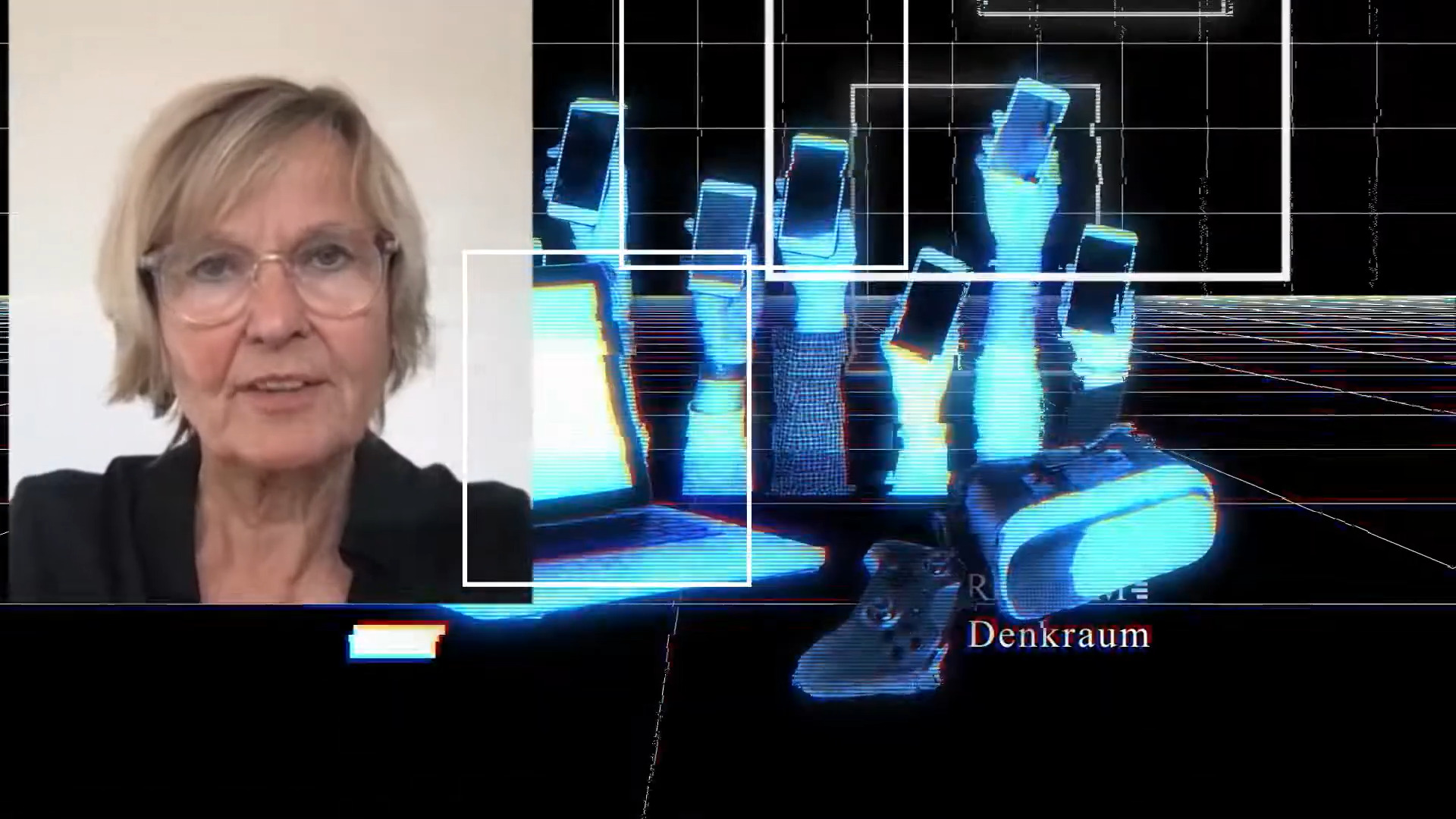
  Cultural globalisation since the 1990s would not have been possible without the transition from analogue to digital communication. Digital, global, real-time communication, made possible by smartphones and social media, has created what cultural scientist Felix Stalder calls a ‘culture of digitality’.[1] In contrast to the more technical concept of digitalisation, digitality is a concept from cultural studies and the social sciences that grasps the interconnections of the analogue and the digital and identifies them as the main characteristics of culture. Digitality thus refers to a cultural phenomenon of the globalised contemporary society, which both ties in with existing habits of media communication — writing letters or telephoning — as well as decisively changing everyday lives in terms of how people communicate with each other and inform themselves. While digitalisation has made global communication possible for almost everyone who has access to digital devices, it is the digitality of culture that has changed the quality of communication and with it the modes of perception and experience worldwide. Everyday activities — whether eating together, sex, sport, care, work, art appreciation — are increasingly taking place in an ‘onlife’, as the Italian philosopher Floridi calls the interweaving of the digital and the analogue.[2] And this ‘onlife’ also characterises the performing arts. Debates in cultural studies and the social sciences tend to take digitalisation to imply a loss of proximity, trust, affection, devotion, etc. in a vein of cultural criticism, or as a euphoric expansion of global communication. I advocate neither cultural pessimism nor naïve euphoria. Rather, I ask how ‘onlife’ has changed the perception of artistic stage performances.

Fig. 1: Gabriele Klein in a still from 'Ferner Körper. Berührung im digitalen Alltag'. Germany, 2022. Video. https://youtu.be/4kh3e6Vi6-s?feature=shared.

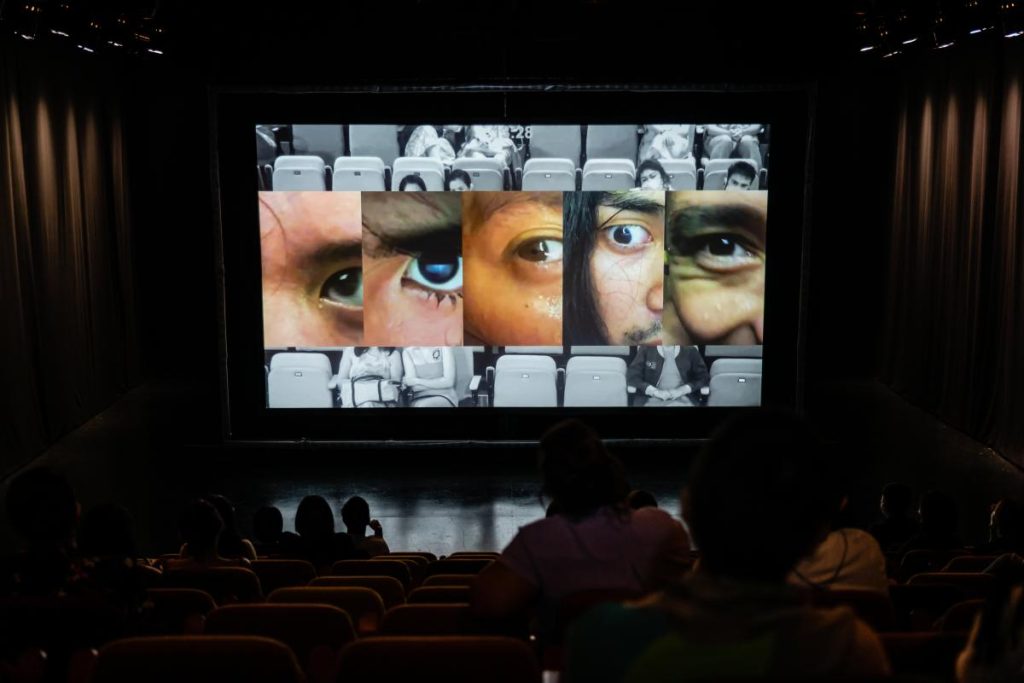
The stage is the last bastion of the analogue. Co-presence, aura, event, unrepeatability are the central features theatre scholars use to distinguish theatre from other media. But what happens when either the audience is absent from the location of the performance, or the audience is sitting in the theatre but the performers are not on stage? Is it no longer possible to affect the audience? Is it no longer possible to be touched by a piece? I argue that touch — even in stage performances — is independent of physical presence. This thesis diverges from some positions in theatre studies, but it is not new to media and film studies, having been often proposed. However, even media studies usually fail to answer the following question: what determines whether an audience is touched? I claim that this being touched happens through the possibility and ability of sensual co-presence. By sensual co-presence I mean an apprehension of sensing, feeling and experiencing, which certain media can induce.[3]
Stage performances in hybrid spaces

Stage art has always seen itself as a bulwark against digitality and virtuality. The theatre, unlike the cinema, is seen as a place of co-presence between performers and audience, and the performance as a unique event shared only among those present. But this perspective had already begun to falter by the turn of the 20th century. Since then, the theatre has faced strong competition in the form of cinemas. In 1895, the first film ever was shown in the Wintergarten, a famous variety theatre in Berlin-Mitte, and the history of cinema — and with it the history of a global medium — began. To this day, there remains controversy — intensified by pandemic-induced closures – about the social legitimacy of subsidising theatres as sites of bourgeois representational culture (still or again) in contrast to commercially operated cinemas and what distinguishes theatrical and cinematic experiences. Theatre scholars cite co-presence as one such distinction.[4] In the 2000s, German theatre scholar Erika Fischer-Lichte defended the particular mediality of theatre by emphasising the co-presence of actors and audience members, i.e. their physical presence in one place, as a special characteristic of theatre and deducing from this the uniqueness of the theatrical experience. She understands co-presence as an interaction where actors and spectators assemble in person in a specific place for a certain duration.[5] Fischer-Lichte understands co-presence as a basic condition for the possibility of affective contact with the audience. Since in cinema, television and the internet, audience and actors are not together in one place but scattered globally, according to Fischer-Lichte, they experience no co-presence and no affective connection can take place. Her concept of co-presence has been repeatedly criticised. As media scholars have shown, being touched is just as possible via analogue and digital media as it is in the theatre. One can root for the main character in a TV movie, empathise with the worries and hardships of the protagonist in a novel, cry while listening to recorded music, get goose bumps or be reassured when a film ends happily. There is no need for both the actors and the audience to be present in the same place; physical co-presence is not a prerequisite for being touched. Being touched takes place in the tension between sensing, feeling and experiencing, and it changes according to the mediality of the medium and its sensual perception. One is immersed in a novel or film through empathetic understanding and imagination, while at a dance performance one can feel the movements of the dancers and possibly even smell their sweat in the front rows. The choreographer Pina Bausch, for example, loved stages with water, earth and grass because these natural materials also exude unique scents.[6] So can you understand a digital presentation as a co-presentational theatre performance? The Filipino choreographer and visual artist Eisa Jocson has addressed this question. Jocson took the pandemic as an opportunity to develop the piece ‘Manila Zoo’, which is the name of the actual zoo and botanical garden in Manila. Six performers are connected to the Mousonturm theatre in Frankfurt, Germany by a video chat. The audience is in the theatre. They show the audience the physical and psychological effects of the pandemic via tile images. They make clear that the consequences of the pandemic are distributed unevenly by class, gender, profession and age. At the same time, the piece deals with power and the economy of the gaze: it shows footage of sex work, the exploitation of performers in Asian Disney parks and the display of bodies and desires put into the picture. In doing so, through the medium of the video chat, the performance gets close to the audience’s bodies in a way that would not have been possible in a stage performance.

Fig.  2: da:ns fest. 'World premiere of Manila Zoo 2021'. Singapore: National Gallery Singapore, 2022. Photograph. https://www.nationalgallery.sg/magazine/maria-labo-aswang-female-rage.

The liveness of global stage publics

It is an integral part of media history that media have not only brought about a globalisation of the public sphere, they have also promoted the formation of different, globally distributed media publics and increasingly fragmented the existence of the audience. For example, listening to music on demand is hardly new thanks to reproduction technologies such as shellac and vinyl records, CDs, MP3s and streaming. Analogue media can include live broadcasts, making it possible to enjoy a classical-music concert via radio and to watch a play on television. But today, when stage performances are shown globally, it is via streaming services and cloud media libraries that stream in real time or minimally time-delayed. And unlike broadcasting, for example, where an indefinite number of recipients are connected live via a broadcasting system, users download these products individually and are connected directly to the server as clients. Multimediality is the hallmark of digitality, which means that the respective media refer to each other. To grasp multimediality in the digital, media scholars Jay David Bolter and Richard Grusin have introduced the term ‘remediatisation’. They understand this to mean ‘the representation of one medium in another medium’[7] and emphasise reciprocal dependencies of media on each other, insofar as they imitate, outdo or otherwise repeatedly reference each other, both establishing and simultaneously undermining the boundaries of individual media. In the course of this remediation, various audiences emerge who, scattered around the world, can follow a concert, an opera or a theatre and dance performance simultaneously. In addition to the audience present, there are other groups of spectators who attend live (remotely) via various media. From this point of view, a live audience need not be physically present, only ‘remotely present’. Accordingly, the media and art theorist Philip Auslander argued as early as the late 1990s in his book Liveness[8] that presence only acquires the aura of authenticity and genuineness through awareness of the simultaneous presence of other remote audiences. The physically co-present situation is therefore not fundamental; it is not the original form of social interaction that is then transmitted by media. Rather, what is ‘authentic’ in globalised media societies is first produced via media transmissions and then interpreted as genuine and auratic. This disrupts perception and induces uncertainty. Is the situation that one is observing real? And can what is communicated through the media be understood as a pure transmission of this reality? Or is it not rather the case that what is considered real is permeated with media?

Global publics and the disruption of atmospheres

Given the media fragmentation of global publics, it comes as no surprise that attention in the performing arts and media and theatre studies has increasingly shifted to the audience, which has its causes not only in the ‘performative turn’ and performance art, but also in the simultaneous incursion of the digital into stage arts. It is no coincidence that this change of how we perceive audiences comes at a time when digital technologies continue to spread globally. As with performative projects, media users are no longer passive recipients but (inter)active participants. From the outset, they have greater scope to engage, because, unlike in the theatre, they can decide how to sit, for example, whether to interrupt their viewing, cook or iron while doing so, or comment on what they have seen in a chat. They are no longer bound to watch the action silently and to comment on it, if at all, only after the performance. On-site audiences and remote audiences are each embedded in different configurations of emotional connection. Whether stage performances can impress and affect an audience depends on whether the play has aesthetic quality and the individual performance goes well, which no one can guarantee in advance. In addition, success depends on the individual habits of perception, viewing experience and knowledge of the audience. Finally, on-site and remote performances differ in terms of the atmospheres in which the viewers find themselves, be it a theatre space, a cinema, in private or in public. This includes the fact that the routines and rituals of cinema, broadcast television and streaming audiences differ from those of audiences physically present at theatres, dance and opera performances. What the spectators on site have in common is that the atmosphere is created communally, and each audience member follows a similar economy of attention. Their attention is focused, which is fundamentally different from the scattered attention of remote viewing, in which different things are perceived simultaneously and the event is brought into a different atmospheric situation, e.g. into one's own home and circle of friends.

Fig.  3: blowUP media GmbH. 'Die 138qm Media Stage an der Reeperbahn in Hamburg'. 2021. https://invidis.de/2021/02/dooh-media-stage-launcht-auf-der-reeperbahn/ (Special thanks to Carolin Baumann)ii.

Sensual co-presence

Events in the performing arts, which have historically been based on physical presence, have always been flanked by technical media such as radio, television, photography and film. Here, digital media mean an extension on the one hand and a fundamental change in the patterns of perception on the other. With digital media, there is a simultaneity of various audiences that does not function through physical presence, but through a feeling of being there or being gripped, imagining an atmosphere at the present time. The experience is thus not independent of time and place in the same way as, for example, reading a novel. Digital media have added a new facet to the understanding of presence: sensual co-presence. Those who are present are co-present, regardless of whether they are on site or remote. The concept of co-presence has moved away from a clear definition of time and place towards a concept that foregrounds sensory perception in digital communication based on participation. Sensual co-presence arises in a hybrid interplay between stage performance and media transmission. It is dependent neither on the simultaneous participation of the audience nor on their physical presence. Rather, sensory co-presence is based on the ability to immerse oneself in the situation with the senses, to understand what is seen with feeling and to imagine the atmosphere created in the play. This requires the ability to empathise with what is being transmitted. In order to develop these abilities in a globalised culture of digitality and to reflect on them, the performing arts provide spaces for critical experimentation.
[1] Felix Stalder, Kultur der Digitalität (Berlin: Suhrkamp, 2016). [2] Katharina Liebsch and I have tried to illustrate and theorise this in our book. This text builds on the argument there. See: Gabriele Klein and Katharina Liebsch, Ferne Körper: Berührung im digitalen Alltag, Reclam. Denkraum, (Ditzingen: Reclam Denkraum, 2022). [3] See Klein and Liebsch, Ferne Körper, 84-98. [4] Erika Fischer-Lichte, Aesthetics of the Performative (Frankfurt: Suhrkamp, 2004), 38-74. [5] Fischer-Lichte, Aesthetics of the Performative, 47. [6] Gabriele Klein, Pina Bausch's Dance Theater: Company, Artistic Practices and Reception (Bielefeld: transcript, 2024). [7] Jay David Bolter and Richard Grusin, Remediation: Understanding New Media (Cambridge, MA: MIT Press, 2000), 45. [8] Philip Auslander, Liveness: Performance in a Mediatized Culture, trans. Liveness (London: Routledge, 2008).
bibliography
Auslander, Philip. Liveness: Performance in a Mediatized Culture. Translated by Liveness. London: Routledge, 2008. Bolter, Jay David and Richard Grusin. Remediation: Understanding New Media. Cambridge, MA: MIT Press, 2000. Fischer-Lichte, Erika. Aesthetics of the Performative. Frankfurt: Suhrkamp, 2004. Klein, Gabriele. Pina Bausch's Dance Theater: Company, Artistic Practices and Reception. Bielefeld: transcript, 2024. Klein, Gabriele and Katharina Liebsch. Ferne Körper: Berührung im digitalen Alltag. Reclam. Denkraum. Ditzingen: Reclam Denkraum, 2022. Stalder, Felix. Kultur der Digitalität. Berlin: Suhrkamp, 2016.
citation information
Klein, Gabriele, 'Digital stages. Sensual co-presence in hybrid performances', Ben Kamis ed. global dis:connect blog. Käte Hamburger Research Centre global dis:connect, 20 February 2024, https://www.globaldisconnect.org/02/20/digital-stages-sensual-co-presence-in-hybrid-performances/.
Continue Reading

Tears through the Red Sea

andrea frohne
 

Elsa Gebreyesus (Eritrean, born in Ethiopia, lives in Fairfax, Virginia, USA), Silenced V, 2010, mixed media on paper, 30” x 37”, photograph by Andrea Frohne.

Silenced V contains the front page of the newspaper Red Sea (ቀይሕ ባሕሪ), published between 1997 and 2001 in the Tigrinya language. The blue and green colours across the artwork represent the Red Sea along the coast of Eritrea and the Horn of Africa. Elsa Gebreyesus tore the newspaper’s masthead in half and pasted it onto the canvas.[1] Underneath, she inscribed the word ‘Silenced’. The artwork depicts a rift and disconnection from globalised processes in the country’s political and social fabric resulting from the suppression of free speech and access to information. In addition, the torn newspaper evokes the torn relationships among Red Sea maritime nations in the Horn of Africa. It connected countries through trade and cultural exchange for centuries. Yet the sea has also existed as a site of disconnection and regional conflict. Born in Ethiopia to an Eritrean family, Elsa Gebreyesus moved at age seven with her family to Kenya during the Ethiopian Revolution. After spending her youth in Kenya, she moved with her parents and siblings to the USA and then to Canada. Elsa Gebreyesus has dislocated or emigrated from homes and then reconnected to new countries five times. The first two departures, out of Ethiopia and Kenya, were from countries that were not native to her. The artist lived in Eritrea following a 30-year war for independence. She worked for five years in the 1990s with a women’s nonprofit organisation in Eritrea and fled prior to a governmental crackdown. Like many of her generation, Elsa Gebreyesus was caught up in the celebration of Eritrea’s independence from Ethiopia in 1991 after the Eritrean War of Independence, and she decided to move to Eritrea in February 1992, setting foot in the country of her heritage for the first time in her early twenties. Putting her management skills to work, she promoted gender equity for five years at a women’s nonprofit called the National Union of Eritrean Women.[2] Toward the end of her stay, Elsa Gebreyusus witnessed a vibrant free press for a brief time in Eritrea from 1996 until 2001. By 1997, several privately run newspapers would sell out every morning.[3] The atmosphere of freedom and optimism about Eritrea’s future impressed her and informed a series of artworks she developed 15 years later. By 1997, the government began implementing increasingly repressive measures. Even though in that year, a carefully written and debated new constitution that grew out of the fight for liberation was passed, it remains unimplemented to this day. The exhilaration and possibility of the newly independent Eritrean nation in 1991 had dissipated as another dictator had risen to power: Isaias Afewerki became president in 1993 and remains in power. Since the 1998 Ethiopia-Eritrea border war, the borders of Eritrea have been controlled or closed, with its inhabitants largely prohibited from crossing them. The nation-state’s disconnection from globalised processes is repressive. Elsa Gebreyesus eventually found it necessary to leave Eritrea in 1997, and she witnessed the continuation of the dictator’s takeover from her new diasporic home in the United States. Inspired by her observation of Eritrea’s free press from 1996 to 2001, she used her art to help her process Eritrea’s change of trajectory toward repression and global disconnection. The path to dictatorship in Eritrea occurred in a series of stages, reaching a culmination in 2001. The September 2001 state crackdown effectively distanced Eritrea from transnational processes, and it continues to this day. From the United States, Elsa Gebreyesus watched closely and anxiously as all independent newspapers in Eritrea were abolished, and all captured journalists were imprisoned in one fell swoop.[4] To this day, no one knows where they are imprisoned or whether they are alive or dead. The Guardian profiled each journalist in 2015 in a world-news article.[5] In contrast to the state newspaper, Elsa Gebreyesus’s collaged newspaper fragments for the Silenced series are from the independent, privately owned papers that existed in newly independent Eritrea during the few years of press freedom. The artist selected sections of newspapers with dates in order to mark the national liberatory moment, and she also chose articles related to mundane aspects of life.[6] The latter includes, for example, a bicycle race in Silenced V. Yet even such innocuous words have in effect been censored since these newspapers are not housed in libraries and institutional archives. The copies the artist used were smuggled out of Eritrea and given to her in the diaspora. Elsa Gebreyesus’s artworks reconnect the memory of these newspapers to her new African diaspora. It is only from her position in a diaspora that she possesses the ability to narrate this history. The disconnection or tear through the Red Sea produces tears of sorrow for many reasons. Yet within the artwork, the small pieces of newspaper remind us of the freedom to write.   [1] The naming tradition in Eritrea is to refer to a person by their first name. The surname is simply the first name of the person’s father. Because it would be awkward to refer to my artist as Elsa only, I take the naming convention that scholars follow, which is to always write the first and last name of the artist. So in my text, you will see ‘Elsa Gebreyesus’ throughout. [2] Elsa Gebreyesus, Telephone Interview with Andrea Frohne, 2 December 2015. [3] Gebreyesus. [4] European Asylum Support Office, EASO Country of Origin Information Report: Eritrea : Country Focus (Luxembourg: Publications Office, 2015), 22, https://www.easo.europa.eu/news-events/easo-issues-country-origin-information-report-eritrea-country-focus. Commission of Inquiry on Human Rights in Eritrea; Report of the detailed findings of the Commission of Inquiry on Human Rights in Eritrea. United Nations Human Rights Council (Geneva: 5 June 2015). https://www.ohchr.org/en/hr-bodies/hrc/co-i-eritrea/report-co-i-eritrea-0. A principal finding of the United Nations commission is that, ‘[F]ollowing the 2001 crackdown, there has not been any press freedom in Eritrea. At that moment, the Eritrean Government suppressed the emerging free press by closing down independent newspapers and silenced journalists by arresting, detaining, torturing and having them disappeared’ (148). [5] Abraham T. Zere, ‘“If We Don’t Give Them a Voice, No One Will”: Eritrea’s Forgotten Journalists, Still Jailed after 14 Years’, The Guardian, 19 August 2015, https://www.theguardian.com/world/2015/aug/19/eritrea-forgotten-journalists-jailed-pen-international-press-freedom. Abraham Zere is a journalist who publishes articles about Eritrea from beyond its borders. [6] Gebreyesus, Telephone interview with Andrea Frohne.
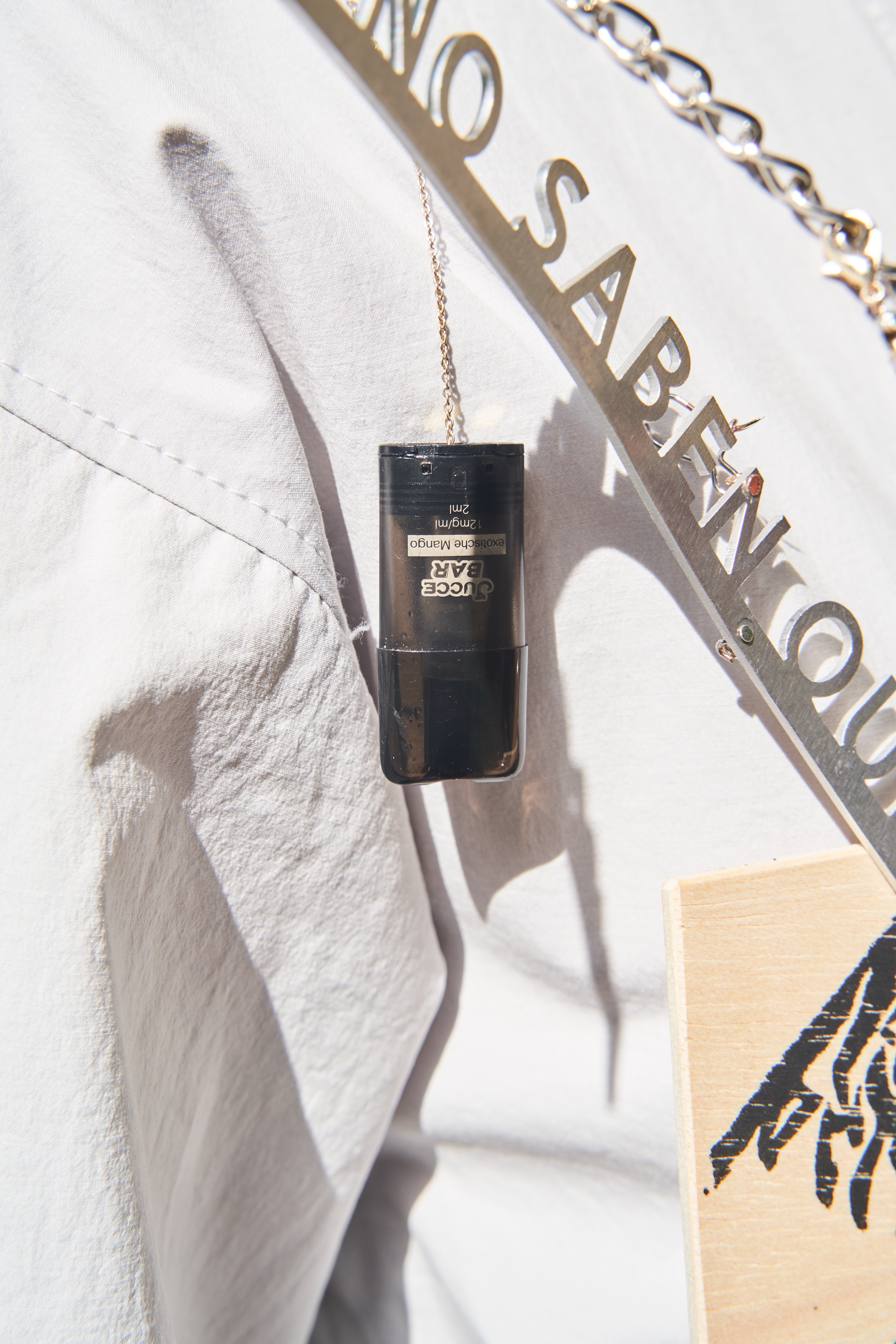
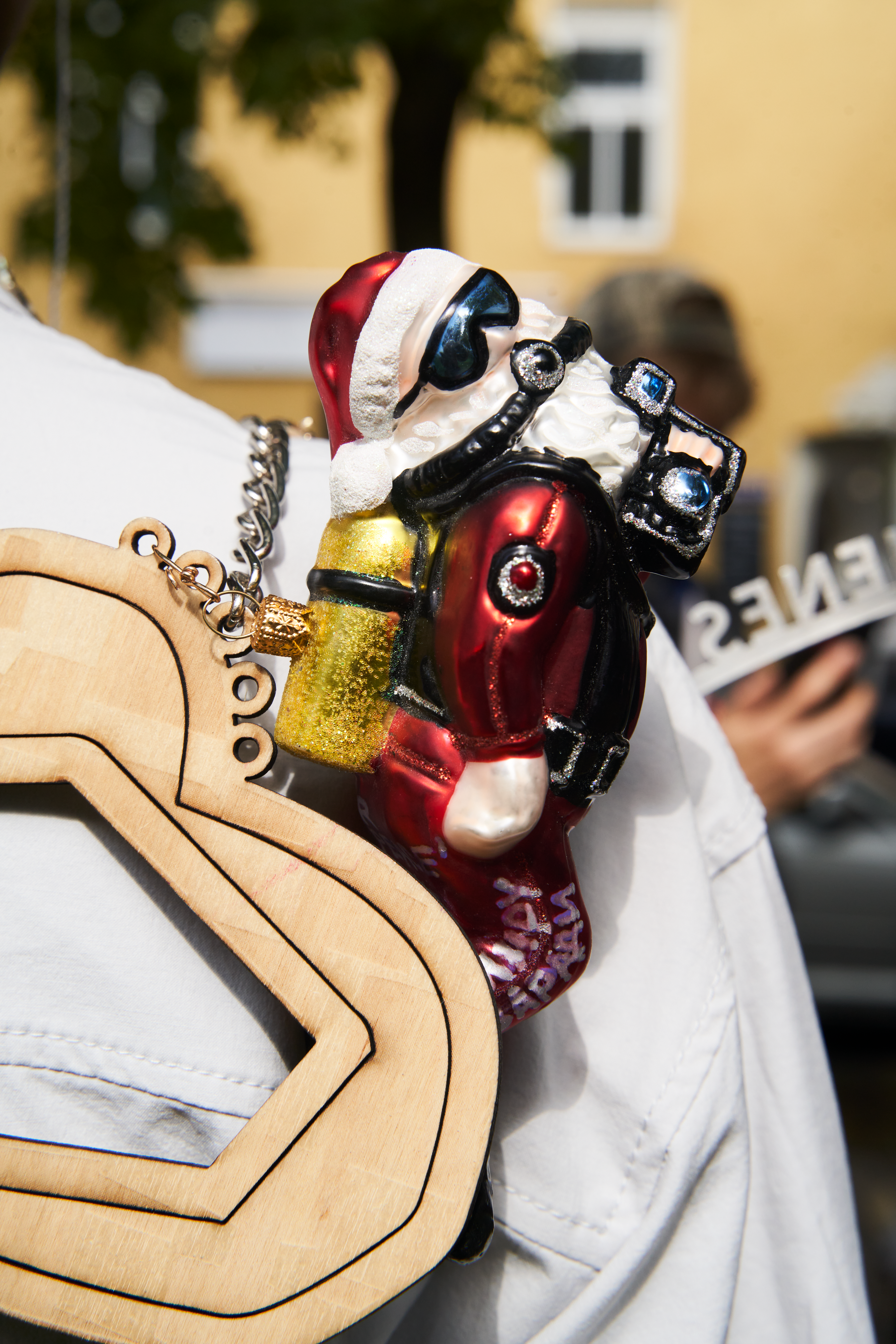
Bibliography
European Asylum Support Office. EASO Country of Origin Information Report: Eritrea : Country Focus. Luxembourg: Publications Office, 2015. https://www.easo.europa.eu/news-events/easo-issues-country-origin-information-report-eritrea-country-focus. Gebreyesus, Elsa. Telephone Interview with Andrea Frohne, 2 December 2015. European Asylum Support Office. EASO Country of Origin Information Report: Eritrea : Country Focus. Luxembourg: Publications Office, 2015. https://www.easo.europa.eu/news-events/easo-issues-country-origin-information-report-eritrea-country-focus. Gebreyesus, Elsa. Telephone Interview with Andrea Frohne, 2 December 2015. Report of the detailed findings of the Commission of Inquiry on Human Rights in Eritrea. United Nations Human Rights Council (Geneva: 5 June 2015). https://www.ohchr.org/en/hr-bodies/hrc/co-i-eritrea/report-co-i-eritrea-0 Zere, Abraham T. ‘“If We Don’t Give Them a Voice, No One Will”: Eritrea’s Forgotten Journalists, Still Jailed after 14 Years’. The Guardian, 19 August 2015. https://www.theguardian.com/world/2015/aug/19/eritrea-forgotten-journalists-jailed-pen-international-press-freedom.
citation information
Frohne, Andrea, 'Tears through the Red Sea', Ben Kamis ed. global dis:connect blog. Käte Hamburger Research Centre global dis:connect, 23 January 2024, https://www.globaldisconnect.org/01/23/tears-through-the-red-sea/.
Continue Reading

‘Not only cast steel or chiselled stone; people can be monuments too’: an exploration of the Memory Person

cathrine bublatzky and franziska windolf

When we think of monuments, we think of statues, memories and events from the past. They are site-specific, solid, immobile. How can they represent cultural and collective memories that are remembered by many, often very differently, and that over time experience new readings? How can monuments installed by institutions, organisations and states speak to and for everybody?

What bodies can do the creative work of memory? How can the actual labour of memory be foregrounded, its training, sharing and transmission?[1]


These questions are relevant to agents in the fields of memory studies and memory production, such as artists, cultural practitioners, institutions, governments and, most importantly, for various communities and people in their everyday lives.

[It] … is on the ‘act’ of memory, … inquiring into the processes of making, constructing, enacting, transforming, expressing, transmitting cultural memory through art and popular culture. … The notion of ‘performing memory’ thus presupposes agency.[2]


The Memory Person (they/them), ongoing since June 2023, by artist Franziska Windolf offers a common form of memory production. The Memory Person performed memory as ‘an embodied and localised practice’[3] and was conceptualised in Munich during an artist residency at the Käte Hamburger Research Centre global dis:connect and in partnership with the ERC-funded METROMOD research project (Relocating Modernism: Global Metropolises, Modern Art and Exile at LMU Munich).

In their joint exploration, anthropologist Cathrine Bublatzky and artist Franziska Windolf explore how the Memory Person represented a striking tension between the concepts of memory, monument and performance.

A performative monument

The Memory Person strolled through the Giesing quarter, a former workers’ district in southeast Munich. The performance was enacted by different persons who embodied a variety of identities, genders and agencies. They were strikingly dressed, carrying several commemorative objects and memorabilia on their body. Each object has its own history, creators and memories. At the heart of the public artwork were ongoing and dynamic encounters between the Memory Person and passers-by, their lively and personal interactions, their shared stories and memories. The Memory Person was dedicated to creative people who have migrated or are living in exile, and anyone could participate.

Not only cast steel or chiselled stone; people can be monuments too.[4]
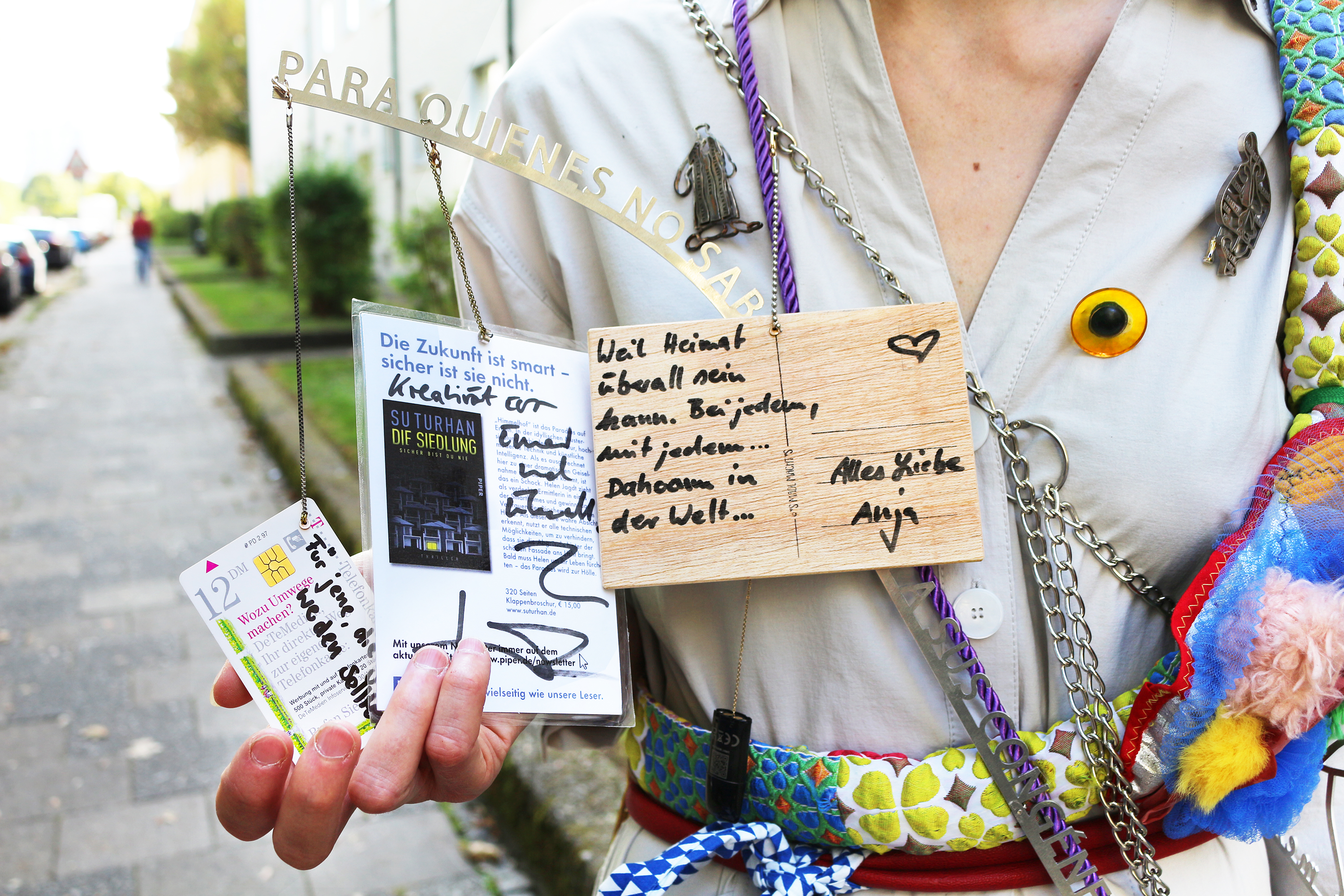
 

The Memory Person challenges the idea of ‘performing memory’.[5] As a performative monument, they work with what anthropologists call the agency of humans ‘to create and construct their own reality’ and to ‘collectively … shape themselves in their behaviours and beliefs’.[6] Performing the Memory Person entailed an uninterrupted metamorphosis in which their ‘form’ kept changing. Their performances merged practices of collecting, storing and re-narrating, all resulting in a changing monument.

The public artwork becomes and operates as a performance based on the material interaction and dialogue with people in the streets.


Those who encountered the Memory Person are diverse. Some have long lived in Munich, some have moved from another country, others have migrated or even fled war and other crises in their home countries. All have memories, often not shared with wider publics, as they are intimate and personal, sometimes even traumatic and frightening.


The Memory Person is a living monument that does not represent a particular memory or hegemonic narrative. They produced a host of memories of differently shared pasts in cities like Munich, shaped by migration and mobility.

A nomadic plinth celebrating diversity

The Memory Person is a practical invention. Due to the lack of publicly accessible knowledge about creative migrants, exiles and their work in greater Munich, memories and biographies must be actively sought out in order to become visible.

As a living monument, they stimulate an interplay of creative expressions and reflections. The collection of memories and memorabilia, and their endowment to people is open-ended.


The web of relationships between the memorabilia changed with each new contribution. The Memory Person decentralises and mediates whilst connecting shared memories with people. This flexible and responsive artistic form is open to renegotiation and emergent values. Their sharing and (re-)telling is on display, mediating memory culture as a lively, contested practice.

The Memory Person and their counterparts became ‘facilitators, knowledge producers, hosts and vision seekers’.[7]


The Memory Person as a performative monument is alive and constantly ‘becoming’.

But what is actually remembered in such unforeseen encounters?

Encountering the Memory Person

Often, curiosity and eye contact sparked encounters with the Memory Person. Their colourful, unconventional appearance, which defies stereotypical assumptions about a carnival or the Oktoberfest, attracted attention and made people wonder what the Memory Person was all about. Once they grasped the goal of the performance, many started to talk about their connections to Giesing and other residents, artists and migrants. They referred to creative people and places. Upon a second, deeper encounter, they contributed personal commemorative objects as fragments of their memories.

The creativity of the monument is very broad and includes music, tinkering, crafting, knitting, cooking, graffiti, etc.


Thus, the Memory Person addressed as many people as possible. Their objective was to raise awareness of the lack of memorials for migrants and creative people in the neighbourhood. Everyone was invited to celebrate and honour the creativity and work of past and present exiles and migrants by participating.

The initial performances of the Memory Person in June and July 2023 were a curated city walk to sites of exile in Giesing, revealing their continued relevance with a pre-selected audience. The spectators accompanied the Memory Person and witnessed their encounters and interactions with passers-by. Participants were invited to carry the memorabilia with the Memory Person and to contribute a wish for a future monument, a memory or a memento of a creative migrant who once lived or moved to Giesing.

The performances in August and September 2023 were more frequent, focussing only on encounters with residents and passers-by. The route through the district was more improvised, with time and space to revisit people and businesses, play table tennis, etc. On these occasions, the Memory Person collected memorabilia and commemorative articles devoted to creative exiles and migrants from anyone who wanted to commemorate.

How the Memory Person embodies the monument and interactions with participants in the artwork is shaped by three elements:

  1. The Memory Person opens encounters by approaching passers-by during a curated city-walk (June/July 2023) whilst strolling through the neighbourhood without a pre-selected audience (August/September 2023);

  2. Alternating subject positions between the Memory Person and passers-by/audience;

  3. Evolving artwork when the artwork is relationally produced with participants.


All three registers played out in each Memory Person performance. But the performances in June/July 2023 were less dynamic and open, as the Memory Person held a fixed position as the ‘guide’ to explain and share knowledge during the curated walk. The material contributions to the performative monument were largely predetermined (written notes on textile/foam rubber prepared by the artist).

The evolution of the artwork is produced more ‘by’ than only ‘with’ the participants.


By contrast, the performances in August/September 2023 provided more space for give and take, including returning moments and memorabilia. Due to the spontaneity of the encounters, the Memory Person and the passers-by had more freedom to participate and exchange objects.

Ethics of dialogue/‘commoning’

‘Commoning’ refers to art that is produced by, not only with, the participants. The Memory Person is the formation and interplay of relationships and their material effects that shape social space and animate memory cultures.

‘The wider challenge here is that of finding new ways of understanding forms of being-in-common that refuse or exceed the logic of identity, state, and subject. In other words: how to be in common without creating a community?’[8]


If ‘commoning’ is when people in a community or neighbourhood become equal in sharing their diverse memories, how does the prescribed content balance with individual conceptions of the monument?

The more reciprocal insights, the more equitable the dialogue and the more shared reflections and relationships can emerge.


Individual identities and property rights don’t apply, as is evident in the ‘materiality’ and ‘objecthood’ of the performative monument. The focus lies on togetherness and the common production of a new monument, whilst the particularities of each person involved gain space to express themselves.

‘The more reciprocal insights, the more equitable the dialogue and the more shared reflections and relationships can emerge.’[9]


The monument belongs to no one, though the objects the monument comprises signify belonging, which inheres in ‘commoning’.

Amanat

All memorabilia engender the dialogues. They resemble amanat, which is a Persian word meaning something that one gives to another person as a custodian. This requires awareness and trust – a sense of the reciprocal capacity and will to build a meaningful relationship.

The object becomes a signifier of a shared moment of remembrance and a common (emotional) value that represents other things such as the conversation, a memory, a loss or a personal or communal journey.


The amanat contributes and ‘transforms’ the world, memories, exile and identification.

The emerging performative monument becomes a common gift to creative exiles and society from all participants.

The different materialities of the performative monument speak for the coexistence of different voices and situations to which the artwork responds or is created within.


The silver brooches, for example, are given away, so they should be as durable as possible. The Memory Person provides a platform for (re)composing and (re)evaluating the objects. Objects converse with each other and provide a ‘language’ for often ineffable stories. There is no definite way of ‘reading’ them.

Diversity is the core of the performative monument, representing an anti-hierarchical, even decolonising understanding of what the Memory Person as a ‘living monument’ embodies.


The actual labour that needs to be done when underrepresented/invisible knowledge is sought out emerges. Contrasting the glorious surfaces of conventional monuments, the Memory Person allows for the contradictions, detours and failures that occur when people are building relationships. The Memory Person responds to recent decolonial debates and demands for monuments and statues of a contested, colonial past to fall.

The past is created by and about participants’ voices. The Memory Person performs it without repeating it.

[1] Liedeke Plate and Anneke Smelik, Performing Memory in Art and Popular Culture (London: Routledge, 2013), 2ff.

[2] Plate and Smelik, Performing Memory, 3.

[3] Plate and Smelik, Performing Memory, 5.

[4] Sebastian Adler, Spectator of the performance, 24 June 2023.

[5] Plate and Smelik, Performing Memory, 7.

[6] Plate and Smelik, Performing Memory, 7.

[7] Vera Hofmann et al., Commoning Art — Die transformativen Potenziale von Commons in der Kunst (Bielefeld: transcript Verlag, 2022), 34. https://www.transcript-verlag.de/media/pdf/f2/e6/9e/oa9783839464045.pdf. Unless otherwise indicated, all translations are by the authors.

[8] Harry Walker, ‘Equality without equivalence: an anthropology of the common’, Journal of the Royal Anthropological Institute 26, no. 1 (2020): 148, https://doi.org/https://doi.org/10.1111/1467-9655.13183.

[9] Walker, ‘Equality without equivalence’, 147.

bibliography


Hofmann, Vera, Johannes Euler, Linus Zurmühlen and Silke Helfrich. Commoning Art — Die transformativen Potenziale von Commons in der Kunst. Bielefeld: transcript Verlag, 2022. https://www.transcript-verlag.de/media/pdf/f2/e6/9e/oa9783839464045.pdf.

‘global dis:connect’. Käte Hamburger Research Centre global dis:connect, 2023, www.globaldisconnect.org.

Plate, Liedeke and Anneke Smelik. Performing Memory in Art and Popular Culture. London: Routledge, 2013.

‘Relocating Modernism: Global Metropolises, Modern Art and Exile (METROMOD)’. METROMOD, 2023, www.metromod.net.

Walker, Harry. ‘Equality without equivalence: an anthropology of the common’. Journal of the Royal Anthropological Institute 26, no. 1 (2020): 146-66. https://doi.org/https://doi.org/10.1111/1467-9655.13183.

citation information:
Bublatzky, Cathrine and Franziska Windolf, ”Not only cast steel or chiselled stone; people can be monuments too’: an exploration of the Memory Person’, Ben Kamis ed. global dis:connect blog. Käte Hamburger Research Centre global disconnect, 12 December 2023, https://www.globaldisconnect.org/12/12/not-only-cast-steel-or-chiselled-stone-people-can-be-monuments-too-an-exploration-of-the-memory-person/.
Continue Reading

Field surveys, Western modernity and restituted global disconnections

andrea e. frohne

Fig. 01: The juxtaposition of the Kansas wheat field, the imported Afro-Italian cart and Dawit L. Petros’s hands suggests migration, mapping of territory and colonial settlement of the prairies.


Surveying a wheat field

The setting for figure 1 is a wheat field in Osborne, Kansas, which has a historic distinction that is central to its self-definition: it was designated by geographers as the geodetic centre of North America.[1] A national system based on coordinates came into use in the late-nineteenth century to survey the continent. A federal agency created what is called a triangulation station at Osborne, making it a fixed and central point. Networks of triangles are calculated eastward and westward from there to survey longitude, latitude, elevation and shoreline (fig. 2).[2] Osborne marks the point from which surveying and global positioning extend in all directions across North America.

Fig. 02: Triangulated mapping that emanates from Kansas as a means to survey the nation-state.

Dawit Petros’s work asks, ‘What is one’s relationship to place?’[3] He underlines through global conversation the complicated transnational, polycentric trajectories underlying a sense of place. One trajectory is a mapping system that contributed to modernisation in North America. As such, it is an end result of the colonisation process that claimed land from indigenous peoples across the North American continent. The artwork therefore engenders a disconnection regarding the stereotype that the Kansas prairie is occupied by European Americans, both historically and today. For instance, African American pioneers settled Kansas in the late-nineteenth century, and their descendants remain today. Another trajectory regarding the sense of place is Dawit Petros’s invocation of Clement Greenberg’s critical look at Western modernist painting, which dominates the methodological understanding of art in the field of art history. Figure 1 invokes a disconnection from this mainstream Western art history.

Surveying modern European art history

In a formative 1965 article titled Modernist Painting, Greenberg expostulated, ‘Flatness, two-dimensionality, was the only condition painting shared with no other art, and so Modernist painting oriented itself to flatness as it did to nothing else’.[4] The monochromatic square of colour in figure 1 is reminiscent of the history of modern Western art, including Abstract Expressionist American art from the 1940s through 1960s. The influential critic Clement Greenberg labelled the style of art ‘Color Field painting’. Artists such as Helen Frankenthaler, Sam Gilliam, Frank Bowling, Mark Rothko and Barnett Newman painted large fields of single colours. The flat, solid colours, understood as pure and monolithic, became the sole subject matter of the artwork. Greenberg contrasted the Color Field artists’ treatment of space in terms of flat planes with the earlier representation of three-dimensional space by ‘Old Masters’ through one-point perspective and the horizon line. Dawit Petros refers to Greenberg’s framing of Western art history. The artist manufactured a set of barellas, or handcarts, used among Habesha peoples in the Horn of Africa.[5] He travelled with a three-dimensional barella to Kansas, photographing it against land (fig. 1). The artist aligned the top white wooden handle of an olive-green square against the white horizon line that divides the field from the sky. The alignment can only be observed by a slight interruption in the horizontal green line that splits the top half of the entire photograph into a field of white colour and the bottom portion into a field of green. Dawit Petros identifies the horizon line but stops short of using the one-point perspective perfected by Renaissance artists. Instead, he references the Color Field style.

Fig. 03: A photographic archive by Dawit L. Petros of earth, sky and built form from Ethiopia.

The flat, olive-green square in the centre of the photograph was sourced from images of Ethiopian land using a process of enlarging digitalised photographic details.[6] The photographed colours are in fact digitalised details of the ground and the earth from Ethiopia (fig. 3).[7] Dawit Petros photographed various patches of ground in Ethiopia, and in each one a dominant colour was brought forward. Dawit Petros then abstracted the colours from the photographs using computer software to generate a square of colour. By using photographs sourced from his visit to Ethiopia, Dawit Petros draws Ethiopia and the Horn of Africa into ongoing dialogues about modernity. The artwork effectively invokes a restitutive global reconnection. In figure 1, the olive-green plane or field of colour is placed on top of what at first glance appears to be another flat plane of colour. But on closer inspection, the bright green, flat colour ‘field’ that forms the background of the bottom half of the artwork is a field, in the literal sense, of Kansas wheat. Therefore, a photographed slice of Ethiopian land is held against a photographed section of land in Kansas. Because of the use of modernism’s two-dimensional flat planes instead of the Renaissance’s illusion of three-dimensional space, it appears as if the geographic distance between the green Kansas field and the olive-green Ethiopian-sourced colour field has now been collapsed and eradicated. In effect, the artist has disconnected the physical separation between two continents.

Reconstituting global processes

The artist stands in the middle of the wheat field behind the green square, and only his two hands can be seen (fig. 1). The bodily presence of the brown hands and the Ethiopian-sourced olive-green square inscribes an African presence into the work’s polycentric modernities in a way that does not objectify the black or brown body. The artist explained in an interview that he decided not to place the body on display, but used the barella to stand in for the body, and that ‘within that refusal is agency’.[8] The African presence in the middle of Kansas iterates a narrative of postcolonial migration and new African diasporas. Dawit Petros lived in Kansas for the duration of an artist residency, and his encounter with Ethiopia for this series reminds us of his emigration. Dawit Petros relocated several times after his birth in Asmara, Eritrea. When he was very young, his family moved to Addis Ababa, Ethiopia, and had to leave again during the Ethiopian Red Terror in 1977. The family finally moved to Saskatoon, Canada, where the artist would live out the rest of his youth. The Osborne work alludes not only to new African diasporas but also, through the barella, to colonialism and hidden migrant labour. Dawit Petros encountered a version of the square with handles that serves as a handcart for construction workers when he was in Ethiopia. The handcart was brought to the Horn of Africa through Italian occupation and retained the Italian name in its new home (fig. 4).[9]

Fig. 04: Two women in Ethiopia demonstrating a barella handcart to carry materials.

While barellas signify the Horn of Africa’s colonial history, Dawit Petros exploited the fact that their appearance also evokes works of Western modernism, particularly Piet Mondrian’s squares of pure colour. Dawit Petros was inspired by another Dutch artist named Bas Jan Ader,[10] a contemporary, experimental artist who himself had investigated and interrogated Mondrian in 1960s performance art. Mondrian’s work, created during the first half of the twentieth century, served as a predecessor for the Color Field artists. Dawit Petros disrupts the trajectory of European modernism again by sourcing colour from the Ethiopian land and by referring to Mondrian by way of Ader, himself an immigrant to the United States, in his case from Holland in 1963. This depiction within the artwork of the act of looking from the perspective of someone with a brown body supplants the presumed white male gaze that dominated Western modernism. The primacy given to Western modernity in the history of art is cancelled by the African specificity Dawit Petros brings through the presence of his brown body and Ethiopian-sourced colour fields. The artwork disconnects the idea of a solely white population from the state of Kansas by reminding us of Native Americans, new African diasporas, migrant farm laborers, and antebellum and post-antebellum people of colour living in Kansas. As a result, Dawit Petros decentres modernity into polycentric arenas that coalesce and co-occur by restituting global disconnections in the field of art history and in a Kansas field of wheat (fig. 5).[11]   [1] Dawit L. Petros, Barella & Landscape #3, Osborne, Kansas, 2012, archival digital print, 30 x 40” (76.2 x 101.6 cm), photo courtesy of the artist. [2] ‘Horizontal survey control network in the United States’ (June 1931), Wikimedia (https://commons.wikimedia.org/wiki/File:Horizontal_Control_Network_of_the_United_States_June_1931.jpg, 12.05.2023). [3] Olga Khvan, ‘“Sense of Place” Exhibit at the MFA Marks Homecoming for Dawit L. Petros’, Boston Magazine, 11 November 2013. [4]  Clement Greenberg, ‘Modernist Painting’, in Art and Literature 4 (Spring 1965): 193-201. Reprinted in Art in Theory 1900-1990, ed. Charles Harrison and Paul Wood (Hoboken: Wiley Blackwell, 1993), 756. [5] Dawit L. Petros, interview with Andrea Frohne: Brooklyn, NY, 2014. Habesha refers to people of Ethiopia and Eritrea without specifying the name of a country. Traditionally, it referred to those who live in the highlands, a terrain that straddles the border. [6] Dawit L. Petros. [7] Dawit L. Petros, Notations (A Catalogue of Addis Ababa), Artist’s Archive, 2010, courtesy of the artist. [8] Dawit L. Petros, interview with Andrea Frohne: Brooklyn, NY, 2014. [9] Dawit L. Petros, photograph taken on a research trip from personal archive, n.d. Courtesy of the artist. [10] Dawit L. Petros, interview with Andrea Frohne: Brooklyn, NY, 2014. [11] Dawit L. Petros, Sense of Place series, 2012-2013. Barellas #1-6 in foreground, 2012.  Archival digital prints; enamel on MDF, sapele, and pine. Installation view in Encounters Beyond Borders: Contemporary Artists from the Horn of Africa at the Kennedy Museum of Art, Ohio University, 2016, photo courtesy of Ben Siegel.
Bibliography
Greenberg, Clement. ‘Modernist Painting’. In Art and Literature 4 (Spring 1965): 193-201. Reprinted in Art in Theory 1900-1990, edited by Charles Harrison and Paul Wood. Hoboken: Wiley Blackwell, 1993. Khvan, Olga. ‘“Sense of Place” Exhibit at the MFA Marks Homecoming for Dawit L. Petros’. Boston Magazine, 11 November 2013. Petros, Dawit. Interview with Andrea Frohne: Brooklyn, NY, 2014.
citation information:
Frohne, Andrea. ‘Field Surveys, Western Modernity and Restituted Global Disconnections’. global dis:connect blog, 11 July 2023. https://www.globaldisconnect.org/07/11/field-surveys-western-modernity-and-restituted-global-disconnections/.
Continue Reading

Atis Rezistans at documenta 15: St. Kunigundis meets Haitian Voodoo

peter seeland

Fig. 01: André Eugène: Gede Sekey (2009), here in the St Kunigundis Church in Kassel (while d15). while d15. Image: Čedo Dragomirovic, 21.06.2022.

A human skull opens its jaw. Maybe in an obscene laugh? Metal, cables and wire form its body, which is erect in a coffin. A metal phallus protrudes from the lap. It is a scene that is difficult to reconcile at first with the clearly Christian motifs in the stained-glass windows in the background. A skull without a reliquary in a church? On top with a huge phallus? We are on the periphery of documenta 15 in the Bettenhausen district of Kassel, in the Catholic church of St Kunigundis. We are looking at Gede Sekey, a sculpture of the Haitian collective Atis Rezistans, which is exhibiting here (figure 01). The church was consecrated in 1927 and is made of quarry stone and prestressed concrete. Built in the architectural style of the Heimatschutzarchitektur, the interior is decorated with mosaics and the exterior above the doorway with sandstone figures. The building has been renovated, and it reopened for the first time in 2022 for the d15 exhibition.[1] Atis Rezistans was founded in the 1990s in Port-au-Prince.[2] Today, members from all over the world create art from diverse media and forms. The central themes are Haiti's role in the global postcolonial liberation struggle and conditions in contemporary Haiti. The formal language is influenced by everyday Haitian culture, the social landscape and Haitian Voodoo.[3] The exhibition takes extends throughout the church grounds. An overarching theme is the Haitian Voodoo. A YouTube video gives an impression of the exhibition while the collective performs: https://www.youtube.com/watch?v=kDr3_PjcyWI&ab_channel=documentafifteen But what do Voodoo and Haiti have to do with a church in Kassel? The artworks guide us through the exhibition for answers. Two cross-shaped sculptures by Andre Eugéné made of stacked oil drums flank the entrance to the church (figure 02). The sculptures bear the names Bawon Samedi and Gran Brijit. They stand in front of the figures of Mary and the saints under the entrance.

Fig. 02: André Eugenè: Bawon Samedi (2022), here in front of the St Kunigundis Church in Kassel (while d15).
Image: Čedo Dragomirovic, 21.06.2022.

  To grasp the sculptures, a look at the structure of Voodoo helps. The world of Voodoo is divided into two parts: a mundane world with humans, animals and objects and a transcendent world of spirits and the dead. Homage is paid to the Lwa, the spirits. They were given to people to connect them to the transcendent world. The Lwa are divided into families, called Nasyon.[4] In the case of Bawon Samedi, the stamped patterns indicate his position. He is the head of the Gede, the Nasyon responsible for death and fertility. Through him, one can communicate with the deceased. As one of the popular Lwa, he is a popular motif in Haitian art.[5] In Voodoo, the shape of the cross stands for the crossroads between life and death. Bawon Samedi decides at the crossroads which path the faithful have to take. [6] Death occupies a special position in voodoo. When ancestors pass into the realm of the dead, it becomes possible to communicate with them. It enables a spiritual connection and transmission of tradition through the generations. Gran Brijit, Bawon Samedi's wife, is the guardian of graves and cemeteries.[7] Eugéné thus marks the exhibition site through Bawon Samedi and Gran Brijit as the Ounfo, or cult site, of the Gede. The location of the sculptures in front of a Christian church is reminiscent of Plaine du Nord in Haiti, a Voodoo pilgrimage site whose entrance is lined with a large cross. Colonial powers once forced Catholicism upon the enslaved people there and placed its symbols on Voodoo places of worship.[8] There is a striking reference to this past in front of St. Kunigundis: Haitians displaying Voodoo symbols in front of a church. It’s perhaps more an invitation to dialogue than an act of suppression. There is a transfer of ideas from contemporary, lived Haitian Voodoo to the middle of Europe. A transfer that surely displays aspects of dis:connectivity: just as the common, echoing colonial history connects, spatial and cultural distance simultaneously disconnects.

Fig. 03 : Lafleur & Bogaert: Famasi Mobil Kongolè (2019-2022), here installed in the Lady chapel of St Kunigundis, Kassel (while d15).
Image: Čedo Dragomirovic, 21.06.2022

Entering the church, we come to a Lady chapel with a wooden Virgin Mary flanked by two sculptures of Lafleur & Bogaert, an artist duo (figure 03). Plastic buckets were connected with tape and covered with coloured pills. Congolese flags are stuck between the pills. The title Famasi Mobil Kongolè reveals yet more: the artists allude to the mobile pharmacies of street vendors and so to Haiti's fragile health system. These vendors provide medical care to many Haitians in place of an intact health system. But what does the reference to Congo mean? The answer lies in colonial history. After the island was conquered by the Spanish, the western part, today's Haiti, was left to the French and the indigenous population was almost wiped out by epidemics and forced labour.[9] In order to continue operating the plantations, millions of enslaved people from Africa were forced to Haiti. At the end of the 18th century, 90 per cent of the population were enslaved Africans,[10] most of them from the Congo.[11] Famasi Mobil Kongolè thus refers to the historical connection of modern Haiti to the Congo but also to the disconnection through the diaspora. Objects of health are installed here as in a shrine around the Virgin Mary. Do they represent a plea for relief from the current misery in Haiti and the Congo caused by the colonialism? However, the Haitian reality is here juxtaposed with a Christian-European context. Where otherwise Catholics present petitions, here it is followers of Haitian voodoo who erect a shrine. Leaving the Lady chapel behind and entering the nave, we gaze upon an abundance of sculptures and paintings. Anthropomorphic figures populate the space usually occupied by the pews where the congregation attend services (figure 04, figure 05). At second glance, one sees that the figures are formed from human bones held together by recycled wire, cloth, mechanical objects and plastic. At third glance, one notices artworks in the side niches and a floating platform between the ceiling and the floor.

Fig. 04: View into the St. Kunignudis Church while Atis Rezistans exhibition at d15.
Image: Čedo Dragomirovic, 21.06.2022

Fig. 05: View into the St Kunignudis Church while Atis Rezistans exhibition at d15.
Image: Čedo Dragomirovic, 21.06.2022.

Turning to the niches, we see a sculpture floating in the air at eye level (figure 07). There, where the Passion of Christ is usually depicted, hangs a doll sitting on a horse. Dressed in dark robes and laughing, the right hand wields a cardboard sword. Sen Jak Maje, Saint James the Great, is the title Katelyne Alexis gave to her work in 2015. How is this childlike knight connected to Saint James, who is known as a pilgrim with a dog and a cape? If we look deeper into the Christian-European iconography of Saint James, similarities emerge. According to legend, James stood by Iberian Christians as a warrior against Muslims.[12] Bringing the depiction of George the dragon-slayer and this legend together, the depiction of James as a riding warrior developed in ninth-century Spain.[13] Named Santiago Matamoros, he was invoked primarily in confrontations with Muslims or in the conquest of America,[14] for example, in the sculpture above the main altar of the Church of Santiago in Logroño , which can be compared with the Sen Jak Maje in Kassel. However, Sen Jak Maje does not point his sword at Islam but swings it towards the altar.

Fig. 06: Katelyne Alexis: Sen Jak Maje (2015), here in the St. Kunigunis Church, Kassel (while d15).
Image: Čedo Dragomirovic, 21.06.2022.

But how did a Catholic Saint end up in the title of this work? And how does its iconography relate to an Ounfo? The history of Haitian Voodoo may helps to understand its relationship to Catholicism. Haitian Voodoo has two main origins, both in Africa: The Rada Cult, originated in Dahomey and the Petro Cult, which originated in the area of modern Congo. Neither cult is not clearly defined, and local varieties can differ greatly. These cults came to Haiti on slave ships. There they met in a confined space and syncretism occurred. The new cults synthesised in the melting pot, forming the basis of Haitian Voodoo and differing from each other as much as from their origins.[15] The Catholic colonial powers used the strategy of cultural amnesia to break the people and make them submit. Before being abducted to Haiti, they had to circumvent the so-called tree of oblivion to turn their backs on their cultures.[16] The Christian mission entailed imposing Catholicism by using laws and religious prohibitions to compel the slaves.[17] But instead of mere Christianisation, the cults developed under this repression. It led to some standardisation of the cults and the formation of identities.[18] But violence led also to the adaptation of Catholic elements in Voodoo through forced estrangement and complying with new rules as a means of survival.[19] The cults thus include Catholic saints in their pantheon, merge them with African-rooted deities and incorporate Catholicism into cult practice. In doing so, the Catholic is complementary and superficial rather than dominant.[20], However, iconographic or attributive similarity also often promotes a synthesis rooted in compulsion and steers it in certain directions.[21] This explains Sen Jak Major: Ogún, a Yoruba war divinity, who is considered one of the oldest and most popular West African deities.[22] He is depicted as a warrior on horseback.[23] Thus, he resembles Santiago Matamoros and is associated with him under the name Ogou Feray by early Voodoo, which is also contains Yoruba influences.[24] Sen Jak is thus a syncretism of Santiago Matamoros and Ogún. [25] So, an African god, wearing a Catholic mask through colonial history, turns his sword towards the altar. He points to the religion that committed crimes against his people and culture. Is he drawing attention to the fact that colonialism has not yet been overcome? Is he encouraging the inexhaustible struggle for freedom? Throughout Haitian history, Voodoo consolidates and serves as a retreat and social identity in times of fear and misery.[26] It has also exerted great influence on Haiti's independence efforts and revolutions. Voodoo priest Dutty Boukman is said to have preached about ‘freedom or death’ in 1791 and thus instigated one of the first revolts.[27] Today, Voodoo still stands for the struggle for freedom. The society is still roughly divided into a small, wealthy, Catholic and Westernised elite and an impoverished majority with Voodoo beliefs. The Catholic Church continued its campaign against Voodoo into the 20st century, violent repression continued in 1942. [28] Today, most Voodoo believers are baptised Catholics, and Catholicism is an integral part of Voodoo. Since 2003, Haitian Voodoo has been the official national religion.[29] The altar area is unusually open. Where priests normally say mass, we encounter further sculptures by Jean Claude Saintilus. Notre Dame de Sept Doleurs (figure 07). To the left of the altar she sits on a plastic chair. Blue textiles veil the body, head and shoulders. Only the face of a human skull peers out from the headscarf. Her eye sockets are filled with metal. Around her neck she wears a clock In the lap lies a nest made of wire, on which an unclothed doll with dark skin is bedded. The doll wears a shell necklace. Between the watch and the doll is an open Bible. Matthew 27.20 to Matthew 28.6, the condemnation, mocking and crucifixion of Jesus until the resurrection, are visible. The sculptures immediately bring to mind representations of Mary and baby Jesus.

Fig. 07 : Jean Claude Saintilus : Notre Dame de Sept Doleurs (2015), here in the St. Kunigunis Church, Kassel (while d15). Image: Čedo Dragomirovic, 21.06.2022.

The Catholic reference is obvious. One interpretation could be that the Bible passage and the Child (Jesus?) in combination with the clock are symbols of life approaching death. Many iconographic details seem to indicate that the specific role of death in Voodoo and the image of man linked to it are brought together with Christian ideas. This is also reflected in the synthesis of the formal languages: a Christian Mary made of classical Voodoo cult materials, like recycled material and human bones. The syncretism reaches a climax here. Voodoo iconography is in a constant state of change, and the Catholic influence is one of many.[30] Atis Rezistans are no exception, and they find their own formal language. They imbue bones and waste with spirit and religious ideas. By decorating the bones with objects of the present, they, like the Lwa, span a bridge between death and life, history and the present. That the exhibition, its works and artists inside have sprung from contemporary Haiti is also evident in the ceiling installation Floating Ghetto made of metal, cardboard boxes and cables. Church, sculptures and the installation intertwine in the shadows. It seems to run parallel to the artists intertwined with history, culture and Catholicism. Floating Ghetto depicts the area around Boulevard Jean-Jaques Dessalines in Port-au-Prince. The adjacent neighbourhoods are populated by the poor, and this is where the recycled material comes from. It connects different historical, geographical and social spaces and is understood as a symbol of the city. This is where Atis Rezistans and their works come from. Many of the people whose bones are used spent their lives on these streets. These bones are provided with recycled remains of a global and local economy, so the sculptures are placed in the Haitian history and a global present. The descendants of people who were exploited to generate the wealth on which the modern Western economy is partly built locate themselves in this world. Placed in the middle of Europe, they thus draw attention to their history and the present and invite us to broaden our perspective. On several levels, the exhibition reveals a global dynamic of ideas involving change and syncretism: slavery forces African cults into Haiti. A dis:connective relationship emerges: the cults are connected to their homeland through cultural tradition and religion and simultaneously disconnected through the diaspora and the pressure of repression. Haitian Voodoo emerges under this dis:connectivity. Atis Rezistans brings the contemporary lived Haitian Voodoo through art to Europe. The locally lived Voodoo is embedded in a local Catholic space as a result of global processes of dis:connectivity. Atis Rezistans proceeds cautiously, allowing cultural exchange and avoiding unilateral imposition. Africa, Haiti and Europe all find a place here under one roof. The Gede and St. Kunigundis are in lively dialogue.   [1] Georg Dehio, Handbuch der deutschen Kunstdenkmäler. Hessen 1, Regierungsbezirke Gießen und Kassel (München: Ernst Wasmuth Verlag, 2008), 103. [2] Detailed information can be found on the website of the collective: http://www.atis-rezistans.com/ [3] Rafael Camacho, ‘Photo Essay: Atis Rezistans: Preserving Haiti’s Anticolonial Resistance’, NACLA, Report on the Americas 50, no. 2 (2018): 188–93. [4] Turine Gael and Laennec Hurbon, eds., Voodoo (Tielt: Lannoo Publishers, 2010), 11, And:; Emmanuel Felix, Understanding Haitian Voodoo (Milano: Xulon Press, 2009), 54–56. [5] Gael and Hurbon, Voodoo, 182. [6] Gael and Hurbon, 182. [7] Gael and Hurbon, 221. [8] Gael and Hurbon, 100. [9] George Kohn, Encyclopedia of Plague and Pestilence. From Ancient Times to the Present. (New York: Infobased Publishing, 2007), 160. [10] C.L.R James, The Black Jacobins (New York: Penguin Modern Classics, 1963), 55; Andrian Kreye, ‘Napoleons Schmach: Die Wurzeln des Elends liegen in der Vergangenheit: Haiti bezahlt immer noch für seine Befreiung vor 200 Jahren: Auch damals nahmen die Wichtigen der Welt den Insel-Staat nicht ernst.’, Süddeutsche Zeitung, 19 January 2010. [11] Gabriel Debien, ‘Les Origines Des Esclaves Des Antilles’, Bulletin de l’Institut Français d’Afrique Noir, 1963, 396. [12] Klaus Herbers, ‘Politik und Heiligenverehrung auf der Iberischen Halbinsel: Die Entwicklung des „politischen Jakobus“’, in Politik und Heiligenverehrung im Hochmittelalter, ed. Jürgen Petersohn (Sigmaringen: Jan Thorbecke Verlag, 1994), 233–35. [13] Adám Anderle, Hungría y España. Relaciones Milenarias. Szegedi Egyetemi Kiadó (Szaged: Szegedi Egyetemi Kiadó, 2007), 16. [14] Claudio Sánchez-Albornoz, ‘La Auténtica Batalla de Clavijo’, Cuadernos de Historia de España 9 (1948): 94–139. [15] Luc de Heusch, ‘Kongo in Haiti: A New Approach to Religious Syncretism’, Man 24, no. 2 (1989): 290. [16] Gael and Hurbon, Voodoo, 11. [17] Rosa Amelia Plumelle-Uribe, Victimes Des Esclavagistes Musulmans, Chrétiens et Juifs. Racialisation et Banalisation d’un Crime Contre l’humanité. (Paris: ANIBWE, 2012), 112. [18] Katherine Smith, ‘Sean Jean Baptiste, Haitian Vodou, and the Masonic Imaginary’, in Freemasonry and the Visaul Arts from the Eighteenth Century Forward. Historical and Global Perspectives, ed. Reva Wolf and Alisa Luxenberg (New York: Bloomsbury Publisher, 2019), 243. [19] Daniel Douglas, ‘Pioneer Urbanities: A Social and Cultural History of Black San Fransisco’ (Philadelphia: University of California Press, 1980), 136. [20] Heusch, ‘Kongo in Haiti: A New Approach to Religious Syncretism’, 291. [21] Heusch, 291. [22] See: Baba Ifa Karade, The Handbook of Yoruba Religious Concepts (Maine: Weiser Books, 1994). [23] Hans Gerald Hödl, ‘Afrikanische Religionen II – Einführung in die Religion der Yorùbá’ (Lecture Summer Term 2003, Universität Wien, Wien: Memento Internet Archive, 2003), 10. [24] Hödl, 294. [25] Heusch, ‘Kongo in Haiti: A New Approach to Religious Syncretism’, 291. [26] Heusch, 290. [27] Ghetto Biennale Atis Rezistans, ed., ‘Booklet St. Kunigundis’, 2022 See: Haitian History. [28] Heusch, ‘Kongo in Haiti: A New Approach to Religious Syncretism’, 294. [29] Alfred Métraux, Voodoo in Haiti (Gifkendorf: Merlin Verlag, 1994), 291. [30] Smith, ‘Sean Jean Baptiste, Haitian Vodou, and the Masonic Imaginary’, 245.  
bibliography
Anderle, Adám. Hungría y España. Relaciones Milenarias. Szegedi Egyetemi Kiadó. Szaged: Szegedi Egyetemi Kiadó, 2007. Atis Rezistans, Ghetto Biennale, ed. ‘Booklet St. Kunigundis’, 2022. Camacho, Rafael. ‘Photo Essay: Atis Rezistans: Preserving Haiti’s Anticolonial Resistance’. NACLA, Report on the Americas 50, no. 2 (2018): 188–93. Debien, Gabriel. ‘Les Origines Des Esclaves Des Antilles’. Bulletin de l’Institut Français d’Afrique Noir, 1963. Dehio, Georg. Handbuch der deutschen Kunstdenkmäler. Hessen 1, Regierungsbezirke Gießen und Kassel. München: Ernst Wasmuth Verlag, 2008. Douglas, Daniel. ‘Pioneer Urbanities: A Social and Cultural History of Black San Fransisco’. Philadelphia: University of California Press, 1980. Felix, Emmanuel. Understanding Haitian Voodoo. Milano: Xulon Press, 2009. Gael, Turine, and Laennec Hurbon, eds. Voodoo. Tielt: Lannoo Publishers, 2010. Herbers, Klaus. ‘Politik und Heiligenverehrung auf der Iberischen Halbinsel: Die Entwicklung des „politischen Jakobus“’. In Politik und Heiligenverehrung im Hochmittelalter, edited by Jürgen Petersohn, 177–275. Sigmaringen: Jan Thorbecke Verlag, 1994. Heusch, Luc de. ‘Kongo in Haiti: A New Approach to Religious Syncretism’. Man 24, no. 2 (1989): 290–303. Hödl, Hans Gerald. ‘Afrikanische Religionen II – Einführung in die Religion der Yorùbá’. Wien: Memento Internet Archive, 2003. James, C.L.R. The Black Jacobins. New York: Penguin Modern Classics, 1963. Karade, Baba Ifa. The Handbook of Yoruba Religious Concepts. Maine: Weiser Books, 1994. Kohn, George. Encyclopedia of Plague and Pestilence. From Ancient Times to the Present. New York: Infobased Publishing, 2007. Kreye, Andrian. ‘Napoleons Schmach: Die Wurzeln des Elends liegen in der Vergangenheit: Haiti bezahlt immer noch für seine Befreiung vor 200 Jahren: Auch damals nahmen die Wichtigen der Welt den Insel-Staat nicht ernst.’ Süddeutsche Zeitung, 19 January 2010. Métraux, Alfred. Voodoo in Haiti. Gifkendorf: Merlin Verlag, 1994. Plumelle-Uribe, Rosa Amelia. Victimes Des Esclavagistes Musulmans, Chrétiens et Juifs. Racialisation et Banalisation d’un Crime Contre l’humanité. Paris: ANIBWE, 2012. Sánchez-Albornoz, Claudio. ‘La Auténtica Batalla de Clavijo’. Cuadernos de Historia de España 9 (1948): 94–139. Smith, Katherine. ‘Sean Jean Baptiste, Haitian Vodou, and the Masonic Imaginary’. In Freemasonry and the Visaul Arts from the Eighteenth Century Forward. Historical and Global Perspectives, edited by Reva Wolf and Alisa Luxenberg, 243–63. New York: Bloomsbury Publisher, 2019.
citation information:
Seeland, Peter. ‘Atis Rezistans at Documenta 15: St. Kunigundis Meets Haitian Voodoo’. global dis:connect Blog (blog), 27 June 2023. https://www.globaldisconnect.org/06/27/atis-rezistans-at-documenta-15/.
Continue Reading