-1
archive,paged,category,category-past-events-2024,category-273,paged-2,category-paged-2,qode-social-login-1.1.3,qode-restaurant-1.1.1,stockholm-core-2.3,select-child-theme-ver-1.1,select-theme-ver-8.9,ajax_fade,page_not_loaded,paspartu_enabled,menu-animation-underline,fs-menu-animation-underline,header_top_hide_on_mobile,,qode_grid_1300,qode_menu_center,qode-mobile-logo-set,wpb-js-composer js-comp-ver-6.6.0,vc_responsive

19 July, Wissenschaftliche Utopien und Bildsprachen –  Neue Perspektiven auf (und mit) Otto Neurath

Scientific Utopias and Visual Languages – New Perspectives on Otto Neurath
 

The workshop is intended to connect multidisciplinary perspectives on Otto Neurath’s work regarding scientific utopias and visual languages (including Isotype).
The event is a cooperation of the Käte Hamburger Research Centre global dis:connect (LMU Munich) and the Munich Center for Mathematical Philosophy (LMU Munich).  

 
Please register here by 8 July.
To download the programme, please click here. Please note that this workshop will be held in German. Continue Reading

21-29 June exhibition global Munich. in perspective

Vernissage: 21 June, 18:00-22:00, Habibi Kiosk, Münchner Kammerspiele, Maximilianstr. 26, 80539 Munich  

Processes of globalisation, their effects and their constraints affect each of us every day. Still, the media, politics and academia tend to shape what globalisation means to us. Headlines and political spin reduce our perception of it to sound bites, like ‘Millionendorf’ (a village of millions) or ‘Weltstadt mit Herz’ (a global city with a heart).

The Global Munich. In Perspective exhibition starts from the assumption that globalisation means something very different for many of us. Hence, artists Hêlîn Alas, Aydin Alinejad, Jeanno Gaussi, Sofia Dona, Nikolai Gümbel, Narges Kalhor and Franziska Windolf will tell us their stories of globalisation in the city of Munich.

Hêlîn Alas charts and analyses economies and approaches of the art system, with its implicit privileges based on class, origin and gender. In diversity work LIVE (Lenbachhaus), she invites visitors to playfully retrace the intra-institutional contrast between the outward image of the art system, which emphasises diversity, and its internal homogeneity.

Where can I feel at home in a globalised world? In Gis (‘wisp of hair’ in Persian), their short film, screenwriter Aydin Alinejad and screenwriter-director Narges Kalhor tell the story of Faezeh, who is about to return to Iran from Germany.

Jeanno Gaussi’s art deals with mechanisms of remembrance, the search for identity and attendant processes of social and cultural appropriation. In her work entitled Salaam Kâkâ Bilkâ (‘Hello Uncle Bilkâ’) Jeanno Gaussi reflects on the world of global goods and the markets where they’re exchanged, identifying supermarkets as meeting places for various communities in her own experience.

Nikolai Gümbel’s work is characterised by multimedia and highly contextualised pieces. In his video piece Schichten, die wir sehen (Abschnitt I, Ausgrabung und Modell) (The Layers We See (Part I, Excavation and Model), the artist obliquely treats the emergence of Freiham-Nord, a new subdivision in Munich, to investigate the past and future realms of possibility of a seemingly ahistorical, post-global place that, according to the brochures, is supposed to be open to all.

Franziska Windolf’s art deals with the question of how sculpture and the body can take on personal-political meanings and how they move through speech, history and social relations. In her works, she recollects stories of exile in Munich, begging the question whom or what we actually remember.

Moreover, the exhibition will present a video from the site-specific installation APPLAUS by artist Sofia Dona. The work treats the Starnberger wing of the main train station in Munich as a location of arrival. Combining various stories of mobility, Sofia Dona’s work presents the station as a place that incorporates forgotten stories of various actors in the city’s globalisation narrative.

From their diverse perspectives and biographies, these artists cast a critical gaze on gaps in our knowledge about Munich as a locus of globalisation. As part of the What is the City NOW? Festival, we celebrate diverse perspectives on Munich along with the city’s inhabitants and ask: what does globalisation mean to you?

  Please click HERE to download the programme flyer of the exhibition and HERE for the catalogue.  

The Festival What is the City NOW? is an initiative by global dis:connect, Münchner Kammerspiele (MK), the TUM Center for Arts and Culture, the Habibi Kiosk, balkaNet e.V., Cine Vélo Cité, Städtische Galerie im Lenbachhaus und Kunstbau München, MK:Mitmachen, Refugio Kunstwerkstatt, MK: Musik, Cozy Sound Sytsem, Mittelschule am Gerhart-Hauptmann- Ring, Hochschule München (Faculty of Architecture), EU Horizon Projekt, NEBourhoods: PEARL Creating Cultural Places for Young People in Neuperlach

Curated by Martín Valdés-Stauber with Andrea Benze, Elke Bauer, Sophie Eisenried, Mona Feyrer, Julia Lena Maier, Gina Penzkofer, Marvin Scheler, Janina Sieber und Clara Valdés-Stauber, Jakob Weiß

For more information on the festival programme, please click HERE.   Continue Reading

26-28 June, constitutional history on trial

The symposium discusses new approaches to constitutional history, drawing inspiration from other fields, especially from legal sociology and legal anthropology, new cultural and political history, gender studies, the law and literature movement, global history and the study of transnational phenomena. Numerous questions for an interdisciplinary constitutional history arise, including:


• How can we grant non-state actors proper consideration?

• What methods help to analyse unwritten or uncodified constitutions?

• How do constitutional norms relate to interpretation and practice?

• What patterns of meaning and interpretations of the world do constitutions represent?

• How does normativity relate to narration in constitutional texts?

• What social and religious norms compete with constitutions?

• How do underprivileged groups become subjects of constitutions, and what role do social movements play?

• How can we detach constitutional history from its national framework and develop it into a history of entanglement?

• What neglected sources should we analyse, and what familiar sources require re-reading?


The symposium brings together scholars from various disciplines and explores methods of constitutional history of modern and pre-modern times. The point of departure is a broad understanding of constitutions as the basic orders underlying communities.


Venue: Historisches Kolleg, Kaulbachstraße 15, 80539 Munich   Please register via franziska.nicolay-fischbach@historischeskolleg.de.   The programme can be found here.  
Continue Reading

20-21 June, Mountains dis:connect

Workshop at the Paris Lodron University Salzburg, organised by Martin Knoll (Salzburg), Eva-Maria Troelenberg (Düsseldorf) and Roland Wenzlhuemer (Munich)  
From the perspective of art and cultural history, mountains have not only been an important subject of visual practices, from landscape painting to (travel) photography, they have also been understood as sites that can be highly charged with national, cultural and religious symbolism. Inspired by these neighbouring fields, global history is currently discovering mountains as sites where global entanglements manifest themselves and emphasise how deeply embedded local and regional processes are in global webs of connections and (potentially conflicting) interests.   For long, high altitudes have not played a particularly prominent role in the study of global history. The field’s focus rested firmly on sites and structures whose role in global connectivity was instantly recognisable. Mountains and mountainous regions were often considered obstacles that had to be negotiated, crossed or circumvented, as natural borders, as impassable territory, as hide-outs and retreats, as watersheds and rain shadows. In short, mountains and high altitudes were long regarded as disruptive elements in an otherwise globalising world.
 
  This workshop seeks to integrate the connective and the disruptive perspectives on the role of mountains in globalisation. With its innovative focus on dis:connection, it identifies mountains as sites where connecting and disconnecting processes intersect, and where they create a powerful tension with regards to regional changes.
The workshop will take place at Paris London University Salzburg, Erzabt–Klotz–Str. 1 5020 Salzburg, First floor, room 1.005

Please register here by 12 June .

Please click HERE to download the programme and HERE for the conference report by Argyrios Sakorafas.

Continue Reading

3 June, Munich History Lecture with Glenda Sluga

From the Planetary to the Global, and other lost histories of the 20th century.  
In 2023, the appointment of an 'oilman' to lead one of the most important climate change conferences of our time, COP28, raised some controversy. But it was not the first time that oilmen have taken the lead in international environmental governance. In this lecture, Professor Glenda Sluga returns to this lost history of the involvement of 'oilmen' in the earliest examples of international environmental governance in order to recover the extent and significance of early 1970s' debates focused on the 'planetary'.

Prof. Dr. Glenda Sluga, European University Institute, Florenz/ The University of Sydney

Introduction: Prof. Dr. Roland Wenzlhuemer

Place &. date: LMU Hauptgebäude, Hörsaal M118, 3 June 2024, 6:30-8 pm

Organisers: Department of History, LMU and global dis:connect

  You can find the video of the lecture HERE.   Continue Reading

24-25 April, Disconnections in wartime 1750-1945

Perhaps nothing demonstrates the complexities of globalisation more clearly than war. The international reverberations of Russia’s invasion of Ukraine have painfully exposed the interconnected nature of modern economies and our vulnerability to forces beyond our control, prompting anxious speculations about deglobalisation. Yet, experts agree that the more likely outcome is not isolation, but instead, changing geographies of connection. Similarly, recent historical scholarship has complicated conventional understandings of war as a dividing force, instead emphasizing both the connections and disconnections that it brings in its wake. In wartime, enemies are dehumanised in government propaganda, travel is disrupted, and trade blockades are enforced. Wartime is associated with absences, interruptions, and detours, as lives are lost, scientific exchanges are cut off, and mobilized populations find themselves transported far from home. Yet, war can also create new spaces of interaction and encounter, sometimes across enemy lines. Some of these exchanges are illicit, such as smugglers who evade military blockades, or spies who penetrate enemy territory. Others are more overt, between prisoners of war and their captors, or surgeons who treat enemy combatants. War can provide the impetus for new connections and the widening of geographical horizons in the pursuit of resources, sometimes with lasting consequences. War, in other words, is the optimal lens through which to trace global connections and disconnections.  
Place & date: Munich, 24-25 April 2024

Organisers: Callie Wilkinson and Tom Menger (LMU Munich)

Venue: Käte Hamburger Research Centre global dis:connect, Maria-Theresia-Straße 21, 81675 Munich

  Please click here to download the programme.
Please register here by 17 March.
  Continue Reading

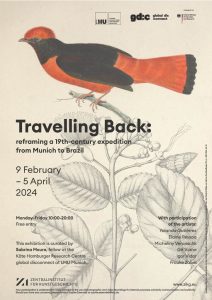
exhibition “travelling back: reframing a 19th-century expedition from Munich to Brazil”


Travelling Back presents a critical perspective on the narratives and collections Bavarian scientists Johann Baptist von Spix (1781–1826) and Carl Friedrich Philipp von Martius (1794–1868) brought from Brazil to Munich in the 19th century. The exhibition follows their extensive three-year journey across the Brazilian hinterland, including the Amazonian region.
Spanning 14 000 km, this expedition took place from 1817 to 1820 and was later chronicled in the multi-volume publication Reise in Brasilien (Travels in Brazil – 1823), providing a personal account of the scientists' encounters and perceptions of the country's varied landscapes, cultures and wildlife.

During their travels, Spix and Martius interacted with various indigenous groups and gathered numerous ethnographic, botanical and zoological specimens. These materials became foundational for several Bavarian institutions, like the Bavarian State Collections of Zoology and Botany, as well as the Königlich Ethnographische Sammlung, now the Museum Fünf Kontinente, established in 1862. Beyond tangible artifacts, these collections also treat the history of Isabella Miranha and Johann Juri, two indigenous children brought to Munich in 1820, who died tragically soon after their arrival. Unlike the scientists' evident presence in the city's landscape, the history of these children is marked by silences and absences in public memorial spaces.

The exhibition raises crucial questions about the coloniality underpinning the scientific pursuits of the natural-history project between Munich and Brazil in the 19th century. It examines the various displays and interpretations of Spix and Martius's collections from their arrival in Germany to the present, and it sheds light on the dis:connectivities of knowledge production behind these scientific endeavours. The idea is not only to inquire into the public reception of these experiences through a history of the gaze, but also to draw a critical examination through the lenses of present-day dialogues and initiatives. This includes new scientific practices of knowledge restitution, literary interpretations and contemporary perspectives from artists like Micheliny Verunschk (Brazil), Frauke Zabel (Germany), Yolanda Gutiérrez (Germany/ Mexico), Igor Vidor (Brazil), Elaine Pessoa (Brazil) and Gê Viana (Brazil).

Curator: Sabrina Moura, fellow at Käte Hamburger Research Centre global dis:connect   Continue Reading

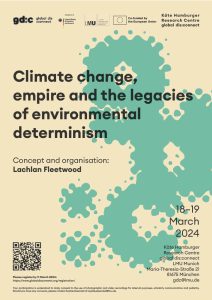
18-19 March, climate change, empire and the legacies of environmental determinism

We live in a time when concern about human effects on the environment and climate are greater than ever. For much of human history, however, the opposite was true, and environments’ and climates’ effects on people were often the more pressing concern. Environmental or climatic determinism – the idea that people are shaped physically, culturally and even morally – by their environments has a long and often insidious history.

Determinist thinking had particular utility in the age of European and global empires in the 19th and 20th centuries, taking on new forms amidst attempts to expand and justify imperial dominance. Everything from ‘energy’ to racial characteristics and from ‘civilisational success’ to the limits of habitability were seen as environmentally and climatically determined. Today, these ideas are once again being reconfigured in new and troubling ways, such as in the deterministic language sometimes employed around climate and migration, which risks echoing racist, early 20th-century visions of ‘nomadic hordes’. With the Anthropocene concept placing human and planetary histories and futures on the same scale, tracing the language of environmental determinism has become imperative.

  This two-day workshop, hosted by the Käte Hamburger Research Centre global dis:connect at the LMU Munich, will thus contextualise environmentally determinist ideas historically and examine their imperial legacies in the face of today’s climate crisis.  

Place & date: Munich, 18-19 March2024

Organiser: Lachlan Fleetwood (LMU Munich)

Venue: Käte Hamburger Research Centre global dis:connect, Maria-Theresia-Straße 21, 81675 Munich

  Please click here to download the programme.
Please register here by 11 March.
  Continue Reading